COVID tinted glasses

The economy kept working under Covid except when it comes to work

Sometimes just a minor change can make the world seem like a different place. The impact of the Covid pandemic has been anything but small, but it has shown up things about the economy that we would have not noticed otherwise. Along with dealing with the virus itself, the economy has also been made a priority, and government measures have been a trade-off between the two. Yet, a lot of what we think as the economy has actually functioned as one would hope under the conditions. It has not been stocking the shelves and keeping the power on that has been the problem, but rather making sure people have money to pay for these things.

The economy is often seen as the system that provides us the things we need. It is set up in such a way that resources, everything from timber to our time, are put to their best use. The result is that we can produce as much as possible using what we have available. This is important as there is a finite supply of most things and higher prices on more valuable inputs is a way of limiting their use. We can thus consume as much as we can afford while also not going overboard.

When looking at the economy as an efficient provider of products, it has held up remarkably well considering the strains it has been put under. Except for panic buying creating temporary shortages, most of the things we might want to buy have still been available. Even though the shops have been closed during lockdowns in lots of places, we have still been able to order things online. This ready supply of goods for purchase relies on both continued production as well as the ability to get products into the hands of consumers. Everything has continued to function relatively well under pressure, especially when considering more disorderly outcomes could have involved chronic shortages and queuing for essentials.

So, when people talk of the need to keep the economy going, it is not due to us not having enough stuff to buy. Instead, it reflects another function of the economy – providing everyone with enough money for their purchases. This is because without paying people for work, we have no other sustainable way of allocating out the capacity to consume. The economy thus plays the role of portioning out rewards for the efforts that people put into their jobs. It shows how the economy is a mechanism for not only deciding what to put in but also how much each person gets of what comes out.  

In normal times, handing out free money is typically frowned upon, either on economic grounds in that it takes away our incentives to work, or morally in terms of people not being worthy of getting something for nothing. Previously, our treatment of those without jobs has become stricter but Covid has prompted a change of tone with government helping out more so than in the past.

This reversal of trend may be because actually doing nothing has some value at a time when intermingling comes at the cost of spreading the virus. But also being out of work and not being able to find a job is not seen as being the fault of the unemployed when the economy has been partially shutdown. It remains to be seen whether this more generous approach to being out of work will stick. But it seems unlikely since governments will likely have to tighten their belts due to more money going out than coming in.

However, the effects of Covid may mean that we may again be confronted with the question of not having enough work for everyone. The lockdowns have accelerated many trends, such as online shopping and working from home, that are part of a bigger shift in which technological progress may be putting people out of work. Replacement by machine has become more of a reality as computer power now means that an increasing range of tasks from driving and making deliveries to investing in the stock market could be automated.

Just like the lockdown left people without employment, technology may do the same. Without work, people would lack their claim on any output from those still with jobs. On top of this, work is more than just a place to earn a wage but also provides an outlet for socializing and a reason to get up in the morning. As such, many people have struggled with being asked to do nothing and would prefer working through the lockdown rather than taking government handouts.

Part of this is due to a preference for employment as then workers would be less worried about whether jobs would still exist after the lockdown ends. But also the idea of being stuck at home for weeks if not months does not appeal without money to spend or places to spend it. If technology stops people from having a job to go to, we will have to come up with new ways of deciding who should do what and also who gets what.

Perhaps an even bigger question is what will we do with our time even if we have the money to get by. Work has dominated our lives for so long that many could not imagine life without it. The capacity for some people to work from home has been available for a long time but until lockdown forced a change, the uptake was limited as we stuck to the traditional concept of the office job despite the benefits of doing otherwise. As well as bringing the future forward in terms of the advance of technological trends, Covid may also nudge us towards rethinking what it means to work.


Economic omelette

The economic is supposed to create new from old but this seems to hurting more

Economist often talk about the economy as a pie but it could also be seen as an omelette in that it requires at least a few eggs to be broken. This refers to the sense in which parts of the economy are broken down and formed again into something new so as to ensure that resources are put to efficient use. This process is an essential part of capitalism as there would be no progress if everything was to stay the same. And yet the breakage involves some economic pain which seems to hurt more than in the past and is making our politics suffer.

This economic omelette-making already has a name, creative destruction. This term was coined to describe how old parts of the economy are destroyed so that new businesses can be created. This is necessary because the economy has limited resources such as the number of workers or shops on a high street. Without businesses going bust or people losing their jobs, it would be a lot more difficult for anything new to ever be made.

It is expected that the resources that are freed up from any economic demolition will soon be put to good use in the newer sectors of the economy. It is thought that workers would inevitably move onto something better as higher wages are typically offer in up-and-coming industries. The new companies could pay more as they exist thanks to new technology or an improved way of doing business that was more productive.

But even the most cutting-edge technology eventually is put to use so much that it becomes routine and easy to use. For example, the earliest computers would have required specialist knowledge to operate but have long ago become basic for most users. The benefit of more people being able to use any given technology expands over time while the wages of those workers will fall as expertise becomes less essential.

The expansion of our knowledge expands drives new technology further in terms of applying even more complex and specialized learning. In pushing the boundaries of what is possible, we come up with technical know-how which typically fewer and fewer people know how to use. The pay is high due to the skills required but such work is only available to the relatively few people can educate themselves enough.

The resulting trends is for existing technology to be simplified while new advances demand more in terms of expertise. Work is thus increasingly polarized between highly-skilled and less-skilled work with little in-between. The progress in computing along with the Internet has been particularly disruptive on both fronts. A lot of middle-class semi-skilled work has been replaced by either a few well-paid workers or a multitude of minimum-wage jobs.

The obvious solution seems to be to invest in more education but not everyone is suited to acquiring large amounts of knowledge. And anyway, schooling systems in most countries suffer from underfunding which means that a lot of effort goes into securing a limited number of routes to good-quality education. Instead, many companies seem to find it easier to import skilled immigrants than to find a ready supply from within their national borders.

On the other hand, technology seems to be developing so as to make use of workers with few skills. For example, an Uber driver does not need to know the streets nor does an Amazon worker have to work out how to put together a shipment as the technology is there to do the thinking for them. While having their skills being taken over by technology, low-skilled workers also lose out as any potential collaboration with more skilled colleagues is limited as more educated workers tend to congregate together in the cities.  

Things are likely to get worse as well as the economic trends are unlikely to change. The full deployment of existing technology has yet not reached its full capacity, without even factoring in the possibilities of advances yet to be conceived of. This economic situation would be difficult to manage at the best of times, and yet the political system is struggling. Any measures to alleviate the issues are hampered as the diverging economic outcomes are further exacerbated by differences in culture, creating tribalism within borders.

A political solution is needed so as to allow for better sharing out of pain as well as the gain. Without intervention, it is likely that destruction will shift from the economic realm into something a lot less creative in politics, resulting in a stagnating economy but fierce battles over how to do things. In much the same way that economic growth creates its own virtuous cycle, the reverse may drag us all down. Thus, if we continue to break economic eggs, we may end up walking on political eggshells.

Big business, small government

Governments increasingly pale in comparison to business but this is about more than size

The title of this post is not a slogan but a mere statement of fact. Globalization has resulted in businesses spanning borders and increasing in clout, whereas governments seem to, if anything, have become more diminutive. This trend not only stems from the bulking up of global multinationals but is also due to changes in the nature of both business and government. The potential solution to weakening powers of government might come from a change in size but to being smaller rather than bigger.

More than ever, bigger is better when it comes to business. With companies able to operate on a global scale, a wider scope of business means that more running costs can be spread over a large volume of sales. Size can bring heft in other ways such as big retailers like Amazon or Walmart being able to get better deals from their suppliers. And for some companies such as banks and many online businesses, their size is the big drawcard with network effects playing an important role in their business models.

Having operations spanning across borders gives companies greater leverage in terms of where to locate. Governments, on the other hand, like business to set up shop within their borders to provide jobs for their citizens as well as to pay taxes. Yet, governments often struggle to get much out of multinational companies. International firms from Amazon to Starbucks are known for managing to get out of paying much tax. Many businesses such as banks or online business also have a habit of getting their own way in terms of regulation. And with lots of funds to spend on lobbying, it is easier for big business to keep government onside.

As the scales have tipped in favour of big business, governments have struggled to get on the front foot. The current fractious nature of politics in many countries means that it is more difficult to form a general consensus about how governments should act. Without a clear sense of direction, governments often seem as if they are flailing. And with higher taxation or more regulation typically involving more government action, such policies make for a tough sell when governments seem so out of sorts.

With politicians finding it difficult to enact policies within their own borders, international cooperation as a means to deal with big business seems well beyond reach. Elites across different country often see the world in similar ways but only because the rise of business works in their favour, which puts them at odds with their many of own countrymen and women who are on the economic backfoot. Any response is further hampered by global firms often being the source of the good jobs that are so prized by both workers and their government.

The solution may not be in bulking up in size to compete with the heft of business but instead in making countries smaller. A smaller nation would likely to have a stronger sense of identity and higher degree of social solidarity, thus helping to facilitate government action. It would also make democracy function better due to politics being less remote while also enabling more grass-roots participation and policies better fitted to the smaller economy. And smaller political units would allow for greater experimentation of different policies rather than a one-size-fits-all measures within the system of globalization. Small might also be better in terms of more pragmatic politics rather than falling back on ideology as a means of governing.  

Part of the argument behind smaller political units is that globalization has done away with many of the function of what a state might have done in the past. The main reason behind bigger being better for countries was in terms of defense, but the interconnectedness created through the global trade system has made it much less likely that trading partners will go to war. Global flows of money and goods also dwarf even the biggest national economies so that even the US government struggles to bend international economic forces to its will. And national prosperity no longer means wealth for the majority of its citizens as it might have done in the past, with regional economic differences within countries becoming increasingly pronounced.

These old elements of the nation state could be realised in new ways with smaller countries. Even though trade might reduce the possibility of war, it would still be prudent for likeminded small countries could band together their less considerable resources to man their mutual defense. And groupings of similar countries might have more success in clubbing together to influence global rules in the same way that the European Union has made some progress on data protection. In this manner, the larger collections of countries could provide the proverbial “night-watchman” role on international matters, while leaving governments free to focus on domestic issues.

While seeming to be optimal in theory, it is still unlikely that anything like this will be put into practice anytime soon. But still, the idea in itself can be used as a reference point to evaluate our current circumstances. One particular conclusion could be that local government will likely help in the implementation of policy. For example, regional leaders did seem to garnish more authority when dealing with the COVID pandemic compared to national politicians who were trying to manage measures over larger range of diverse areas. And a further step in this direction would involve giving more regions the possibility of moving towards outright statehood.

Business is only likely to get bigger as the global market continues to expand and prosperous companies take an expanding share. Instead of trying to compete on size, a multitude of small governments might be the best way to balance out big business.

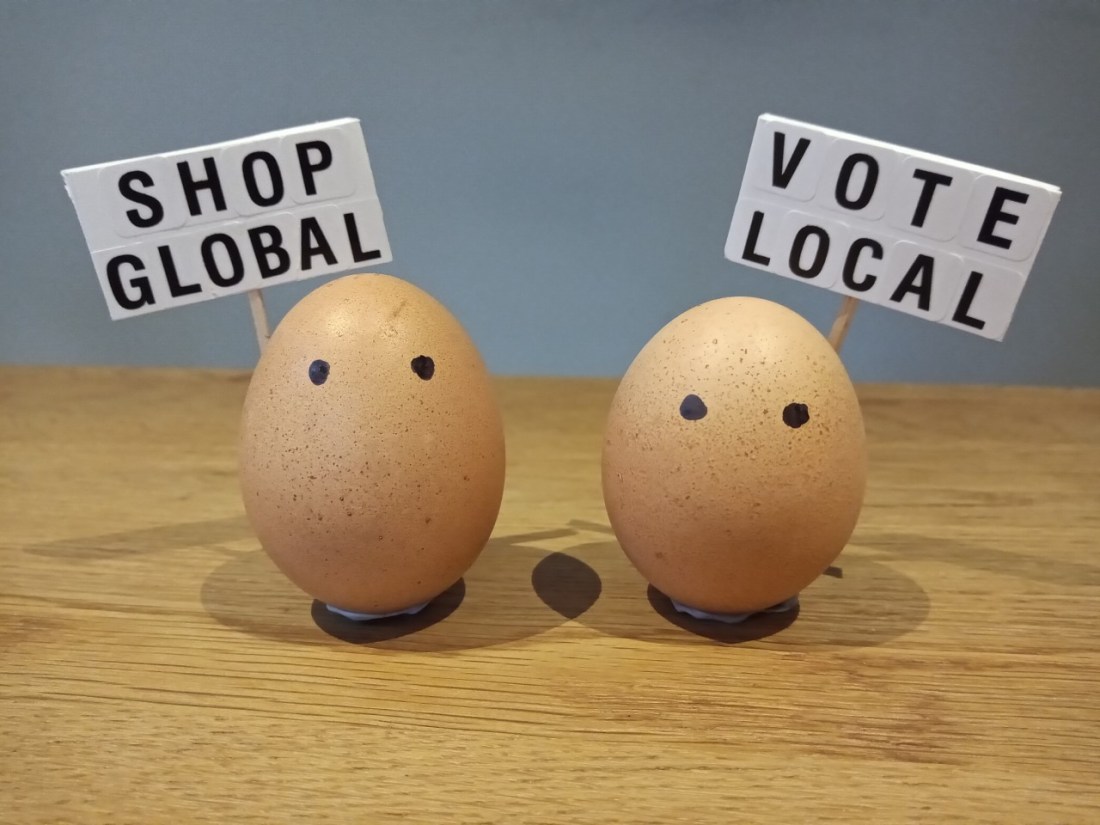
Shop global, vote local

The demand for cheap goods and strong government might be too much

One of the catch cries of the environmental movement urges us to “think global, act local”. This slogan points to how our actions in our community can have an impact on a bigger scale. Paraphrasing this in the title of the blog refers to how the economic and political actions of some can work in opposite directions. When out shopping, we often get lured in by cheaper goods on offer thanks to globalization, while many are voting in opposition to the global economy that keeps prices down. With people being tugged in both directions, there might not be a way out.

From the consumer’s point of view, globalization has resulted in a bonanza in terms of a growing selection of goods at low prices. Everything from clothing to computers has benefited from production being coordinated on a global scale. Globalization can achieve more for less because it increases the size of the market for many businesses. In general, a larger number of goods being produced at one place will typically have lower costs. So it would be cheaper in most cases if goods can be produced in large quantities and then shipped around the world (especially if transport costs are low). This approach also means that production can be situated where it is most efficient rather than close to where the goods will be consumed.

The lower price tags for global goods means that we can buy more, but also that production for international markets is also likely to shrink. The reason being that higher levels of output acts as a spur for automation which involves more machinery and fewer workers relative to the output. Offshoring of manufacturing jobs and basic service-sector work has added to this trend within industrialized countries where the wages are higher than elsewhere. The result is that most people are global consumers to a certain extent, while fewer and fewer people provide goods for the global market.

On top of this, global jobs have increasingly become concentrated mainly in the cities, stripping many other places of high-paying work. The more the pay packets of the locals in such communities take a battering, the greater the attraction of the cheap products that globalization is good at offering up. Even though neighbourhood businesses are likely to suffer due to this, the government has little power to mitigate the impact especially as social solidarity is on the wane. It is not surprising then that many people left behind in the wake of these changes end up feeling powerless and abandoned. Not only have jobs disappeared but individuals have been left with few meaningful ways of contributing to the economy so as to earn a wage.

With the negative effects of globalization being concentrated in specific places, location has become a more important issue in politics. Many people see their own prosperity as closely tied to the economic wellbeing of their own neighbourhood. When this manifests itself in political terms, the nation state thus becomes the obvious flagpole to rally around for those on the economic backfoot. But this resurgence in patriotic sentiment has come with its own problems, and rather than providing solutions, has split society into rival camps that do little but bicker.

An obvious solution would be to get more people to “shop local” as promoted in many corners of the world. Although buying things from stores in your neighbourhood does help a bit, it matters more where the goods are produced (although lots of services are produced locally). The trend to buy locally source agricultural produce (particularly common among people in city who would tend to “vote global”) is a step up but unlikely to be substantial enough relative to the size of global economic flows.

If those who “vote local” can only afford to “shop global”, the situation seems more likely to get worse especially since the political system seems to offer little scope for improvement. Democracy would normally find a way to mediate between competing claims but the traditional split between left and right is not set up to cope with these issues. Instead, it is our politics that is also being cheapened by the division that globalization has wrought. And it is something for which we might have to pay a lot more for as the situation is only likely to deteriorate.

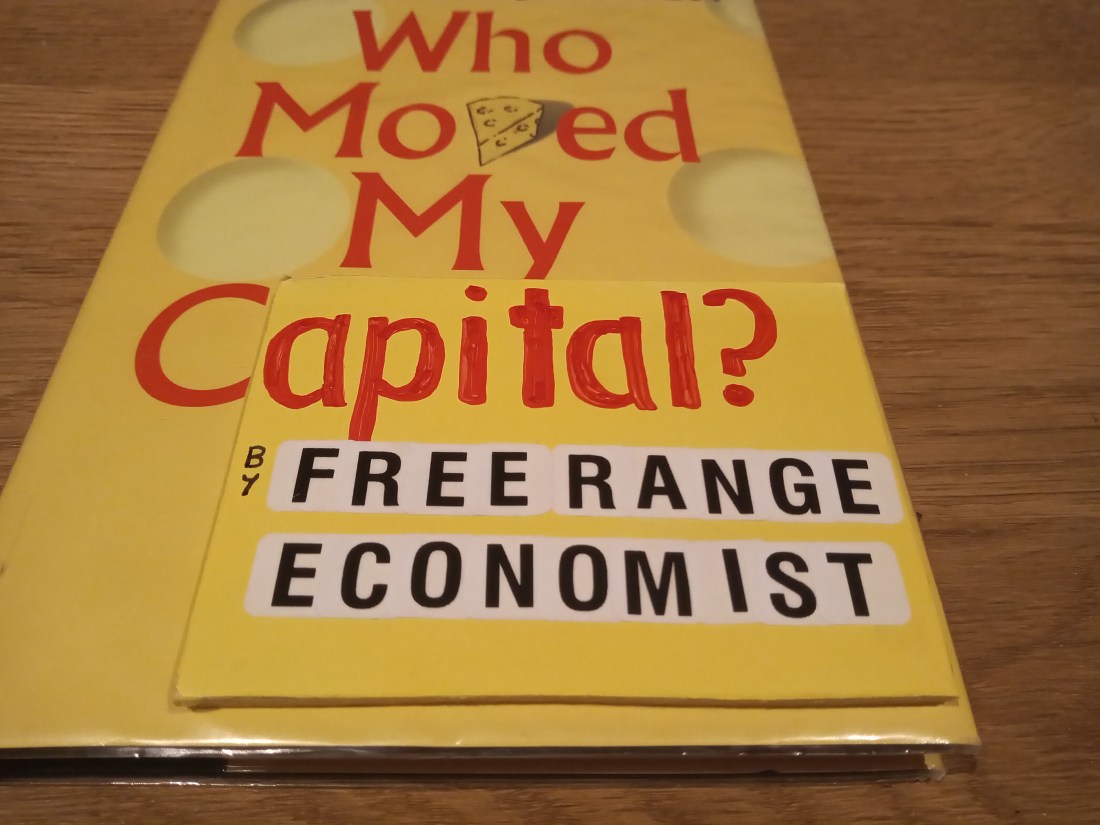
Who moved my capital?

It has become harder for some to earn a decent wage and increasingly others may struggle as well

“Who moved my cheese?” was a best-selling motivational book about how to deal with change in life. Change is something that we have all had to deal with of late amid massive shifts in the economy but it has hit some people more than others. Part of the reason for this is that many of the things needed to make us productive in the workplace have become concentrated in just a few places. It is not only those that have seen their productivity decline that should be worried as this trend might catch up with all of us.

There are two basic inputs that go into an economy, labour and capital, which are mixed together in different combinations to generate output. In this context, capital is what we use at work to help us get the job done and can include anything from a screwdriver to a computer (and even knowledge we have acquired). Improvements in technology means that capital has been able to do more of the work by either making people more productive or by doing away with the need for workers.

This development has increasingly split workers into two camps – those who work with lots of capital and those who work with very little. Part of the reason behind this is the demise of manufacturing which was a productive combination of (wo)man and machine that offered work accessible to anyone with even just a basic education. The automation or offshoring of manufacturing jobs essentially took away the tools of the workers and hence one major route to higher wages. Investment in many areas dropped away as the newer forms of technology were typically employed elsewhere.

On top of this, the economy also shifted away from producing good to managing the growing complexities involved in global production. Such work often involved handling information and required cognitive and analytical skills that required extra education. Skilled workers have thus become the main productive asset in the economy and have migrated to work in the big metropolises of the world. While good for the individuals involved, this gathering of skilled workers in a few locations has resulted in other places losing some of their best and brightest minds.

The effects of the movement of both physical and human capital are profound as the output (and hence wages) of most workers depends on who and what they work with. It therefore makes a big difference whether you do the same job for a local firm or a global multinational, whether it be your colleagues on the job or the resources (such as IT) that help you with your work. As such, people who work outside of the big cities lost access to capital in their work places, both in terms of technology but also in terms of the human capital of skilled workers.

The situation is compounded by the tendency for economic activity to follow capital. More capital at work tends to mean higher wages which can be spend on goods but a large portion is also paid out for services provided locally. So the vibrancy of the local economy typically relies on the capital that workers use at their jobs. If the, let’s call them, de-capitalized workers were spread evenly within their respective countries, their plight would not be such an issue as there would be more jobs either working with or serving the capitalized workers.

Moving the workers to follow the capital might seem like the obvious solution but it is not so simple. Having the productive assets concentrated in a few areas means that the cost of living nearby goes up. Rent and land prices have increased as the supply of housing has struggled to keep up with the influx of people. Other issues also mount up such as congestion, overcrowding on public transport, and pollution. The opposite policy of moving capital back to the people might also seem plausible, but to get the best out of skilled workers, it is increasingly important to have them all working in close proximity.

Some tinkering may help such as better transport links to connect more people with the capital. More could also be done to compensate those that have been left stranded who might otherwise use the political system to claw back lost gains. We should not just worry about what has happened but also what might happen if capital is further concentrated. The result of this would be that fewer and fewer people would be able to earn decent wages, impacting not only the individuals but the health of the economy as a whole. All the more reason to watch where capital might be moving to next.

Paleopolitics

Without a shared way of looking at the world, the changing economy has split us into warring tribes

Diets tend to be faddish but even the Free Range Economist got caught up in the notion of the paleo diet. The idea behind it is that our stomachs evolved over thousands of years to the foods (such as vegetables, nuts, and fish) that we would eat back when we were hunters and gatherers. The same concept can be applied to how are minds developed to operate within small tribes so as to ensure that the group (and hence the individuals within it) would survive. The means by which we have been able to move towards interacting with more and more people has been eroded away as economic changes impact on how people understand the world around them.

Humans, like all other creatures, have adapted over time to better fit in with their environment. Our bodies developed to survive feast and famine and we still store up any extra calories, but rather than being helpful in the modern world, this now causes problems such as obesity. Our minds also are fine-tuned to operate in relatively small groups of a hundred or so people based around the larger family unit. While the world around us has changed, our tribal brain can also play havoc with how we cope with life in a global world.

Previously, the key for survival would be a strong group identity so that everyone would put in their all to guarantee the survival of the whole even if it were to mean sacrifices for the individuals. One way of doing this was to create clear boundaries between those within the group and outsiders who were often viewed with distrust. But the growth of larger and larger social groups shows our ability to go beyond these basic building blocks for society and work together with people from different backgrounds.

The key to managing bigger masses of people outside of our kinship grouping is shared narratives that bind everyone together. These narratives develop over time so that society can expand in size and get individuals working together for the good of the whole. In this way, society became more inclusive despite its past of excluding people from outside a narrow group. Religion and nationalism were two such grand narratives that help large numbers of people work together toward common goals while also accepting new recruits that shared their beliefs.

In more recent times, economic progress has become the rallying cry for society. We rely on the economy for lots of our wants and needs and toil away to do our bit. It is understood that economic activity might result in job losses or businesses going bust, but the economy had also provided people with a way to get back on their feet. The economy does not instill devotion or passion in the same way as religious or patriotic beliefs, but steady improvements in our daily lives meant that most people were happy to do their bit.

Things seemed be going so well with solid growth in the few decades up to the 1970s that people rallied together to form a generous welfare state for the less fortunate. However, these years of plenty slowly melted away with the rise of globalization along with automation and computers that have eroded away economic gains for many. The effects of these trends have not been even but have instead resulted in a large portion of the population seeing their livelihood stagnate while others continued to prosper.

While religion or past national glories might provide some consolation for those who have fallen on hard times, economics provides little comfort. There is the expectation that those without jobs or those not earning high enough wages should move elsewhere or take up new skills to find better work. After all, it is expected that each of us will do our share and thus earn a wage. Yet, what the economy provides, the economy can also take away, and as such, many previously prosperous areas in industrialized countries have suffered from seemingly terminal decline. Flight was the preferred option for many but those who stayed to fight have struggled as economic activity has drained away.

As well as suffering through a lack of job opportunities, those left behind have had to go without a helping hand from their own countrymen and women. On top of this, the story that economics would tell suggests that it is all their own fault and that they have no one to blame but themselves. With this tale not looking likely to have a happy ending, it is little wonder that many have turned to conspiracy theories so as to understand why previously industrious folk have ended up falling on hard times. The situation is further compounded by minorities on issues such as race, gender, and sexuality seeming to be getting a lot more sympathy from some.

For their part, those still happy with how the economy operates see those without work or decent jobs as not playing by the rules. Those who have prospered hold themselves as examples that anyone should be able to succeed. And we rely more on those who thrive to spur on the economy so we tend to have little compassion for those who struggle (which is one of the reasons why tax rates have been falling). Instead, the left behinds are often looked down upon for not being able to keep up with progress or being fooled into supporting populist politicians.

Despite the obvious analogies, this is more than an us-versus-them story but one in which many people have lost faith in their economic future. While immigrants have taken some of the blame, tribalism looks set to become particularly fierce among people that look alike but who have differing economic fortunes. Our past tribal selves might have treated outsiders with disdain, but the worst treatment was dished out to those within the group who did not look after their own. Without a shared story to believe in anymore, our disagreements could swell over so as to push back against further economic progress.

To transcend the tribalism within each different countries, the narrative of economic progress needs to be rebuilt so that it rings true again for the majority of the population. The assumption being that issues of culture and identity could potentially ease if more people had control of their economic destinies. Otherwise, the increasing rancor will continue to mount and only make the issues worse. Tribes are not so good at working together but are instead much better suited to warring with one another. But conflict will not help us progress and is instead more likely to drive us all nutty (and not in the good paleo diet way).

Capitalists of the world united

Skilled and mobile workers benefit from a united front but it cannot last forever

Karl Marx tried to kick start a revolution with the catch cry of “workers of the world unite”. But in this, as in many other things, the father of modern communism was wrong in his reading of history. Instead it is the capitalists that seem closer to unifying around a shared ethos, whereas workers around the globe seem increasingly at odds with each other. The solidarity among the well-off have put them on the front foot as they continue to grab a growing share of global output, but they are unlikely to continue to get their own way.

Capitalists of old were the owners of factories and other businesses who made their living off employing others. Ownership of the means to produce goods put them at an advantage in relation to workers who could only make a living by earning a wage. The status of labourers only improved as the level of their skills became more important to production which put them in a better position to demand higher wages and improved working conditions.

The structure of ownership changed as growing scale meant that businesses could no longer be run by individual capitalist. Instead, corporations that issued shares on financial markets took over, and everyone, whether the chairman or the cleaner, worked for such companies. The level of pay was relatively flat with even the lowest rank of workers able to earn a decent wage (but only in the industrialized countries).

Globalization broke up this relatively harmonious arrangement on two fronts. Due to an increase in the supply of (typically low-skilled) workers across the globe, the higher levels of pay for everyone in the West could no longer be sustained. Yet, skilled workers from the West were now spread thin across the entire global market and so could demand a premium for their labour. In this way, it is not what you own but what you know that has become what defines your status within the economy.

The university-educated are thus now the holders of the valuable productive assets and could be seen as the modern-day capitalists of our time. But different to the capitalist of old, their assets are often put together in combination with each other rather than by employing others with fewer skills (as a factory owner might have done). The result of this has been that skilled workers tend to work together in big cities linked to the global economy but partially separated from the rest of the national economy.

This concentration of productivity in specific locations has resulted in many losing out at the hands of globalization. Previously, manufacturing jobs might have provided a route for people with fewer skills to earn higher wages. As many of the goods produced were destined for export, manufacturing was a means to tap into the gains from globalization. This path to prosperity has been cut off with such production being shipped off to low wage countries. What was left in terms of work for low-skilled workers typically tended to be service jobs supplied to the local economy.

The result of this has been diverging interests between those benefiting from globalization and those who want the domestic economy to be given priority. The differing views have also fed through into contrasting political outlooks. Those with more skills are likely to be happy with the status quo where globalization continues to dominate, while low-skilled workers have become open to options for change. For those wanting something new, populist politicians have risen to prominence through promoting national interest against external threats.

Populist from the left and right have offered up differing approaches, while mainstream politicians struggle to come up with a suitable middle ground. Whatever the policies, the manufacturing industry in the West has continued to be eroded away. With only so many factory jobs to go around, the battle has become a zero-sum game where some workers can only benefit while others miss out. Low-skilled workers in different places are thus pitted against each other in the fight for a brighter future.

The opposite is true of the winners from globalization who are not only benefiting themselves but also tend to have opportunities open up when their peers do well. Thus, the share of the economic pie for skilled workers thus  grows as it feeds off itself. The situation is further enhanced as the high cost of living in the large prospering cities tends to shut out others. Cultural differences between city and country folk adds to the sense of separation. Residents of large metropolises often share more in common with each other, irrespective of location, rather than their countrymen and women.

The low-skilled workers share a similar plight with others in the same situation but who live in other countries. Yet, the reliance on their local economy prevents any common bonds. Their identities too are more rooted in regional traditions, making them more nationalistic in outlook. So even if the number of those left behind by globalization continue to rise, their mounting number may not translate into political strength on a global scale. Instead, they may be left at the mercy of populists, whereby any victories will come with some feel-good factor but no respite.

In this way, it is through populist and the political system that the left behind will fight back even as capitalists continue to pile up the economic gains. United as the global skilled workforce might be, they look likely to lose out as the numbers in opposition mount up in their individual countries. And then any cross-border solidarity will not amount to much if the winners from globalization cannot keep their fellow nationals on side.

Have we reached a globlock?

Growing grievances against globalization may see further progress blocked if left to fester

Globalization seems like a force of nature when considering the expanding rate at which goods circulate around the world. But globalization has also prompted resistance as some have done better than others. Trends suggest that the unequal share of gains from globalization is not likely to change and could instead become more pronounced. With discontent feeding through into the political system, it may reach a point where globalization hits up against its own built-in limits.

Both the growth and demise of globalization could stem from the notion that markets will always grow in size. Successful businesses expand as they search out new customers as well as offer up different products. This process has been given a further boost by the growing ease at which products can be transported. Goods can now be mass produced in one location and shipped across the world, providing benefits in terms of  growing economies of scale. Even online businesses such as Google and Facebook prosper as the reach of their services spreads across the globe.

The expansion of globalization has provided dividends in the form of greater efficiency, higher corporate profits, and cheaper prices. Yet, globalization has attracted increasing levels of unease in Western countries as many workers have missed out with benefits being captured by a shrinking portion of the population. The issue has been further exacerbated as the main means by which economic gains have often been shared (taxes and social spending) have been curtailed in the past few decades.

The bulk of those losing out from globalization in Western countries are made up of low-skilled workers whose jobs can be easily automated or moved elsewhere. While being pushed towards the side lines of the economy, those being left behind still have their political voice. The volume of their resentment has been turned up with the rise of populist in many countries. With their attacks on the status quo, populist threaten to derail the gains from globalization.

This begs the question of whether globalization was always likely to create resistance within democracies and thereby halt its own expansion. The bigger markets and greater levels of automation have resulted in gains that workers had made in the past being eroded away. Manufacturing had opened up a route for low-skilled workers to climb into the middle class (through exports tapping into global markets), but improvements in productivity have meant less need for workers. Transitioning people from manufacturing to the service sector has involved a drop in the level of technology on the job and hence wages.

These trends would still play out even without the economy expanding across borders. But globalization has served to act as an accelerant, both in terms of increasing the rate at which businesses could scale up in size as well as resulting in low-skilled workers (who were already set to lose out from automation) being hit even earlier due to offshoring. The international element also meant that it is the overseas rather than domestic winners from globalization who have been attracting people’s anger.

Governments have also been hampered in their response as globalization has seen its power wane relative to business. Along with their increase in size, the ease at which companies can move operations across borders has resulted in growing leverage over government policy. The resulting business-friendly policies have tended to be good for the global economy but also hampers the ability of governments to deal with the consequences of globalization within their borders.

Populists have stood up as the flag bearers for the anger against globalization as the mainstream political system offers up few solutions. The traditional left/right split in politics is ill equipped to deal with issues such as whether the economy should be more or less open. Politicians may be able to patch together a compromise, but the outlook does not look bright. Without genuine solutions to the economic pain wrought by globalization, the lure of populist will grow and may reach the point at which globalization stalls and begins to be reversed (in Western countries at least).

As much as populism is seen as wayward by those who think that they know better, it is likely to continue as a force in politics if the underlying frustrations that it feeds off remain. And the structural nature of the issues to do with both globalization and the political system means that they will not go away anytime soon. Without any solution in sight, globalization may be stopped in its tracks by, for want of a better term, a democratic globlock. Without enough winners from globalization, we might all lose out.

Where does all the money go?

Banking looks set for further growth even as it plays a less positive role in the economy

Despite all of their bad press, banks have an important function in the economy of getting surplus cash to where it is needed. But the role of banks seems to have changed from moving money around to instead focus on making money grow. This shift, while good for the banks themselves, has come with obvious costs to the point where we should look again at the role that banks play. Otherwise, an ever-bigger banking sector threatens to get out of hand and drag the economy down with it.

The reasoning behind why we have banks assumes that there is only so much money to go around. For one person to have more, someone else had to be willing to forgo spending what they had. Banks thus came into being as an intermediary, accepting deposits from savers and lending this money out to others. In this way, banks ensured that money moved within the economy to where it was needed while also making sure that the money was used wisely.

To make a business out of this, banks charged borrowers a higher interest rate that paid out to savers. Rules related to banking had meant that, to lend money out, banks first needed to secure funds from deposits. Changes in the interest rates at banks helped to balance things out if there were a shortage or an abundance of funds. Higher interest rates would, for example, entice in more savings, while limiting loans to the keener borrowers.

This traditional model of banking now seems to take on less importance with more money coming in than was needed in the economy. Perhaps the trigger for this was the oil shocks of the 1970s which generated piles of cash for the oil producing countries of the Middle East. With no capacity for the local economies to adsorb the money, funds flowed into the banking industry in the West. Whether by sheer chance or not, this seems coincides with the start of a push for increased deregulation.

Bankers were keen to free themselves from regulation as Western economies has reached a point of needing less funding. Industries that relying on lending, such as manufacturing, reached a plateau in the 1970s and fell into decline from thereon in. The service sector, which took over as the main source of growth and jobs, did not need the same level of investment. The rise of computerization further exacerbated this trend toward businesses needing fewer assets.

The extra cash at their disposal, with less opportunities to invest, may have pushed bankers into being more creative in the ways in which they put money to work. Investment banking took off to become the face of finance, leaving behind retail banks that do the donkey work of taking deposits and making loans. Money increasingly came easy to come by due to inflows as the global economy (powered by the rise of China) generated more money than could be put to use for investing in the economy.

This “glut of global savings” was one of the reasons given for the global financial crisis. The abundance of cash found its way into retail banks that were freed up to lend to almost anyone that wanted to buy a house. This generosity was based on demand for, what were at the time seen as, safe assets for investors looking for somewhere to park their cash. Despite having being reckless in some of their practices, few within finance were punished. The banks were also able to escape from having too many new rules imposed upon them as had been the case after the Great Depression.

With their momentum only slightly dented by the financial crisis, the finance sector continues to add to the funds it looks after. The size of this cash pile looks set to grow further as there is no foreseeable limit to the desire for those with money to want more. Demand for most other goods or services, anything from Harley Davidsons to haircuts, will reach a point whereby everyone has as much as they can afford. No such saturation point exists for finance. On top of this, bankers seem to be able to find a supply of new ways of putting money to work even if returns have been falling. Investors own increasing amounts of everything from farms to student accommodation as well as an increasing array of financial products.

Along with the extra profits this brings in for banks, the increase in scale relative to the rest of the economy bring greater influence. Finance takes on greater importance to the high levels of pay for its employees along with the money for taxes (and lobbying). This leverage puts banks at a strong position to get what they want from government as well as influencing the overall  economy. As shown by the lead-up to the global finance crisis, the economy itself is often shaped by the needs of finance, due to the sheer size of the funds involved, rather than the other way around.

In this way, it seems as if banks are working toward more narrow goals where some gain more than others, rather than its previous role where the economy as a whole would benefit. Further growth in the finance sector, as looks likely for reasons already described, may thus have a negative overall effect on the economy. The main way of addressing this imbalance would be for government to impose stricter rules relating to finance. Yet, even in the aftermath of the global financial crisis, the willingness or ability of governments to reign in the finance sector seems limited. It remains to see if too much of a good thing will be too good to turn down.

Move Work Ford

Amid continuous change, the way we work seems stuck in the past

Henry Ford changed the way we work by doubling the wages of his workers more than a century ago. This upended the consensus at the time by suggesting that businesses could make more money by paying out higher wages. Workers were assumed to apply themselves to their work with greater fervour if they feel as if they are being treated better. Fast forward to today and it seems as if we need a modern-day revolutionary to reshape work to fit a changing world. While the level of pay is becoming an issue again, large potential gains in worker welfare as well as corporate profits seem possible from freeing workers from their desks. The problem seems to be not why it should happen but why it hasn’t happened yet.

Change often comes from taking a fresh perspective on what is otherwise seen as normal. Wages for workers had been seen as a cost that was to be kept to a minimum. This all ended when Henry Ford doubled the pay for his employees in 1914 offering, what in the day was a substantial amount of, five dollars a day. The reasons for this large pay hike was to help retain workers but also to ensure that they had enough money to offer to buy the cars being producing in massive quantities. A trend hence ensued in which the pay of workers steadily increased for more than a century, along with various forms of other benefits, such as healthcare, paid time-off, and pensions.

Some of these gains for workers are being lost as globalization expands the worldwide supply of labour. An extra squeeze comes from higher costs for housing as well as long commutes into work as cities expand up and out. These trends seem likely to change as people continue to flock toward prospering areas where much of the new jobs are being generated. Despite all of the growing costs (amounting to more than just money), it seems to be taken as a necessary element of modern-day life, with few efforts made to deal with the issues.

The obvious solution would be for many of the workers who work nine-to-five in offices to do their work from elsewhere. Benefits would not only accrue to the workers themselves through shorter commutes and cheaper housing, but also to companies that would require less office space in prime locations. Workers might also be happy to accept lower wages if permitted to live away from the hustle and bustle. On top of this, the economy as a whole would also get a boost as economic activity would be less centralized in the larger cities, helping out areas feeling left behind despite the growing economy.

Working practices are changing, with tech firms in Silicon Valley starting a craze for a different type of workplace that includes nap pods and snack bars. Less enlightened companies have been employing “hot desks” which leaves workers free to roam while still requiring them to be onsite. The setup of “hot desks” appeals to businesses as it allows for better use of space when many employees might otherwise be away from their desks. It could be a stepping stone so that workers can “hot desk” from anywhere but that day still seems far off despite almost seeming entirely feasible.

The sticking point seems to be the old-fashioned notion that people will only work if watched. The concern is that, if workers are left to their own devices, they will skive off. Instead, company employees are expected to prove themselves by spending longer hours at their desks. Putting in the hours at the office is a way in which companies know that their employees are committed to the firm. With well-paid jobs often involving creative input on the part of the worker, output is both difficult to measures and highly dependence on the individual. Perhaps companies see “time on the job” as the only way of keeping tabs on what their employees are up to. Even the progressive firms of Silicon Valley expect workers to put in the time.

Another reason why workers are kept inhouse may be the power companies seem to have over their employees. Globalization and outsourcing along with the demise of trade unions have stripped workers of much of their bargaining power relative to their employers. Those on lower pay have to submit to zero-hour contracts and a lack of paid lunch breaks. And it seems as if even the better paid workers cannot escape from even longer commutes into the office. It may be that the limited supply of so-called “good jobs” mean that even the more productive workers have to submit to the whims of their paymasters.

To flee from the office, the only option for workers seems to be to set out on their own. Selling your services to businesses, rather than working for a wage, is a way by which workers can take back control of their own labour. This escape route might only be available in a limited number of cases and might also require years of working for a wage to gain experience to strike out on one’s own. But it is a means by which more talented workers can gain bargaining power, while also benefitting businesses who might like the flexibility of farming out work.

For the rest of the office workers, it may require someone like a Henry Ford type figure to kickstart a rethink of the way we work. As the number of people drawn into cities rises, costs for both workers and business will continue to mount, hence providing greater impetus for change. When the time does come, change will be swift but we may have some time to wait yet for it all to begin.