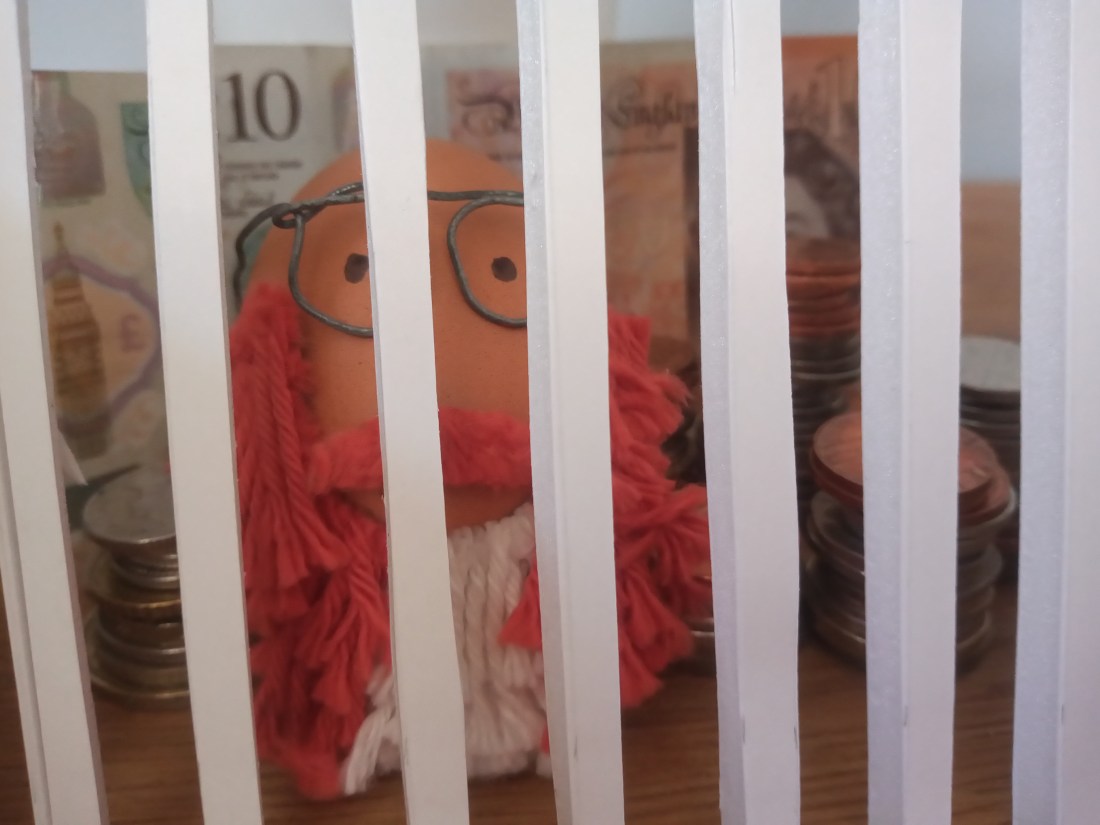
Money seems to be everywhere except where we need it most
Miscreants are often locked up to keep them out of trouble. The same seems to be true of money. Not only do we stash it away for safe keeping but also act to stop too much money getting out into the economy where an excess of funds could create havoc. As such, those able to print money have, over the centuries, found ways of tying their own hands to limit how much cash they could generate. Yet such measures can backfire if the amount of funds free to move around the economy is not enough. While there seems to be plenty of cash around these days, money doesn’t seem to be able to get where it is needed.
The optimal amount of money never required much thought until it was actually something that was printed (on paper) instead of being dug up (as with gold or silver). Initially, the premise for printing money was that the paper notes were in lieu of a precious metal that was safely under lock and key. Not only was it more secure but large transactions were easier without having to lug around a bag of coins. The issuers of notes had to prove themselves trustworthy and not likely to succumb to the temptation of creating more notes that was actually backed by precious metals in the vaults.
It was banks that first issued notes but printing money later became the concern of governments who managed their own currency back by gold under a system which was known as the gold standard. The gold bullion in the vaults acted as a limit to how much cash would circulate within an economy. Growing prosperity with a relatively fixed amount of gold meant that there was likely to be a point at which enough money could not be printed.
Increased wealth also meant more trade between countries and large amounts of gold would cross borders if there was an imbalance between trade coming in and going out. If imports were larger than exports for any country, gold would flow out, thus restricting the amount of money in countries with higher imports. With less money to go around, the economy would suffer, but as a result, imports would also fall so that gold would flow back again and balance would be restored.
The gold standard thus had its own way of reigning in an economy that was overheating. But this process could be quite painful with a steep plunge in economic activity required to achieve even a small fall in imports. And this economic turmoil came at a time when there was no social welfare to help out anyone that would fall into hardship. This was at a time when only a few people had the right to vote and so the widespread suffering that would ensue had little political ramifications.
Eventually, the lack of flexibility in the money supply proved too much, especially when the government needed to spend lots, typically when at war. As such, countries in Europe suspended the gold standard during the world wars and had trouble getting it back in place. A pseudo form of the gold standard was reestablished in the postwar era when the value of the US dollar was fixed against gold while other currencies were pegged to the US dollar. This too was abandoned in the 1970s after a prolonged period of heavy spending by the US government during the Vietnam war.
The new regime involved different currencies changing in value relative to each other depending on the economic circumstances in each country. The money supply fell under the control of central banks who used inflation as a gauge as to the health of the economy. To stamp out inflation in the early 1980s, central banks raised interest rates to punishingly high levels that in many ways was similar to the harsh measures adopted under the gold standard. Yet, inflation has been relatively subdued since then and the economic conditions relatively benign with the notable exception of the global financial crisis (where it was mostly banks who were at fault).
The new monetary regime saw the end of the fluctuations between rapid growth and sharp downturn that had plagued the economy in the past. Policymakers of old did not have the understanding or the data to know what was going on in the economy and thus had to rely on the crude mechanism of the gold standard to manage policy. Nowadays we know a lot more about what is going on and have also learnt lessons from the past, allowing a better response to recent crises as compared with the measures taken which led to the Great Depression.
Yet, it may be the case that we have swapped an economy that would run hot and cold for economic growth that is lukewarm. While the management of the economy is far superior to what we had in the past, it is as if having more scope to direct the economy has increased the fears of doing something wrong. The economy could grow faster except for central banks being wary of getting too close to circumstances whereby inflation might set in. Yet, without any substantial price rises being seen in richer countries for over three decades, it is not certain that inflation would be close at hand.
A sub-optimal economy would not be an issue if there were not concerns that require a response. Potential problems such as growing inequality and climate change would be best if dealt with sooner rather than later, but a lack of funds is often cited as an excuse for not acting. Other areas that deserve more attention such as health and education are left to languish despite the potential to improve the livelihoods of many people. There has been a shift in policy toward doing more to boost the lacklustre economy but the current range of options for policymakers don’t seem up to the job.
What seems to be the issue is not a lack of money but an inability to direct funds towards solving the problems at hand. The main means to deal with such issues in the past was through government, but this path has been hampered by a general aversion to taxation as well as the rise of global business. Rather than being able to invest in the long-term health of an economy, governments tend to rack up debt during economic downturns and then focus on paying back the money when the worst is over. While being able to deal with the immediate crises at hand, the more intransient and structural problems get neglected.
Signs of change are afoot as governments have been more willing to spend, but it still seems as if public debt will act as the bars of the cage that the economy seems to hit up against. Without more resources being directed through government towards dealing with long-term issues, a growing sense of injustice from unresolved problems could fuel a political backlash. One option that has attracted growing attention has been using cash from central banks to provide funds for government to spend or repay debt. The thinking behind such a proposal is that fiscal and monetary policy seems to have reached their limits, but a combination of the two could offer up more potency.
Putting money to work in this way is obviously controversial in terms of requiring a dramatic shift in the way we think about government debt. Abandoning the gold standard also demanded a change in thinking but it was necessary to escape from limits that are self-imposed and hamper further development of the economy. Otherwise, the economy will be stuck in a cycle between inevitable crises which prompt a sharp rise in government borrowing followed by years of growth hampered by debt repayments. And, as under the gold standard, the economy will remain trapped in a cage of our own making.

 Free Range Economist