Growing where

As the economy grows, much of the extra cash may not be spent

We all change as we grow, and this is also true of the economy. With incomes typically rising with economic growth, what we tend to buy changes as well, and this shift in spending also goes on to shape what is produced when we are at work. What we normally think of as the economy typically revolves around things to consume but increasingly money goes towards buying into investments. While this trend is given little attention within economic theory, it is perhaps having a bigger impact than is thought.

There has been a change to the things that we buy as economic growth has progressed. With more people earning bigger pay checks, spending is shifting from things that we need here and now to money put away for the future. Like most things in the economy, more demand for places to put away cash has resulted in an increasing range of options of what to invest in. A whole industry has been built up on providing investment products for those with money where ever they might live.

In the past, any money stashed away as savings in the bank didn’t really earn much. The financial deregulation that started in the 1980s changed this with an increasing emphasis on money being put to work. More choice about where your cash could go also meant that funds could better be directed to areas of the economy where it could be put to the best use. Along with the extra cash to be made by investors, those who played their part in moving money around also got paid well for their role.

Economic theory would suggest that any money put aside is beneficial as it frees up important capital to be used by businesses to expand profitable ventures. Yet, the reality seems to be that many of the large companies have a surplus of cash, much of which is used in share buybacks rather than investing in new business. And banks no longer rely on deposits to issue loans to smaller businesses as they might have done in the past. Rather than going towards supplying goods and services to sell, funds for investment often go into buying an asset that someone else owns and wants to sell. This asset could be a stock or a bond but could also be a property or something more exotic like an artwork or vintage bottle of wine.

It can be assumed that demand for such investments must be growing as the prices for things that people buy to invest in are increasing. Rising demand seems intuitive as greater levels of wealth mean that there is more money available to be invested. For prices to rise, it is not enough for demand to be high but also that supply must be unable to keep up. It seems to be the case that coming up with new ways of making money from money is not that easy. Excess demand is most notable for less riskier investments with some investors prizing safety so much that they are willing to tolerate negative returns on some government bonds.

This trend might be something that is inherent to capitalism and will continue to build up over time. But there are also factors that are not permanent which may mean that demand may ebb away in the future. For example, less money might go into investments due to selling brought on by the retirement of the baby boomer generation who have built up financial assets to provide them with income into their old age. Also, some countries, such as China, also generate surplus capital that is channelled into foreign financial markets but these flows may dry up once options for investing in their domestic markets increase.

Whatever the source of excess demand, the resulting rising prices for financial assets contrasts with the relatively weak demand for goods and services in the underlying economy and the low levels of consumer price inflation. It may be the case that funds diverted towards investment tends to take money away from spending on goods and services which may have contributed to subdued inflation. After all, higher earnings are not likely to translate into more and more consumption, while investments can continue to mount up as incomes rise.

The increasing amounts of money going into investment products has the potential to change the way money flows around the economy. Normal consumption involves buying things that would have been made elsewhere and transported to the location of sale where staff wait to provide assistance. Or it may involve a service whereby an output is provided by someone on request. Purchasing goods and services thus typically involved substantial amounts of labour enabling a wide range of people to earn a pay packet.  

Investment products do involve some labour but the amount of input involved is usually relatively small especially considering the large sums that are typically involved. The workers involved are also concentrated, both in terms of geographical space (financial centres such as New York or London) but also with regard to the type of workers (educated and white-collar). Their spending could also be seen as being different to the average worker such as more money flowing to other places through, for example, the purchase of imports.

While the production of investment goods is narrow in its scope, the benefits from the money put away are also mostly captured by those owning the assets rather than being spread out through the whole economy. Higher asset prices do not serve any economic purpose (an increase in the cost of buying property should increase the number of houses being built but often doesn’t) but instead just results in a shift of funds to the owners of the assets. This issue is likely to worsen as the gap between those who have and do not have money in investments expands as financial assets are becoming pricier while wages (which cannot grow much faster than consumer inflation) are relatively flat.

On top of this rise in inequality and its economic consequences, a bigger finance industry is also problematic in terms of being a source of instability in the economy as seen in the dotcom bubble and the global financial crisis. Growing disparities in earnings also create problems in terms of social cohesion and can impact negatively on the political system. Another potential issue is the effect on aggregate demand in the economy. Not only is potential spending diverted into investment but the extra income going to the wealthy is less likely to be spent. This is because those with high earnings are likely to spend less when provided with more cash to spend compared to people on lower incomes.

The obvious conclusion from this trend is that asset prices will continue to rise as more money gets drawn into investment products unless there is a dramatic shift in either demand or supply. Such a trend would impact on how the economy functions and thus on attempts by policymakers to manage economic booms and busts. For example, the abilities of central banks would also likely suffer as measures such as quantitative easing (designed in part to boost asset prices) would have a diminishing effect. As already mentioned, boosting the earnings of holders of investment has less impact on overall spending and so monetary policy often struggles to gain traction.

Such difficulties have resulted in a recent shift to give greater emphasis on fiscal policy which allows for money to go towards people more likely to spend it rather than add it to their stockpile. Further government action might be necessary to avoid an economy where wealth continues to grow faster than incomes. Such was also the case around a century ago and it took unprecedented social and political change for wage-earners to make up lost ground and broader economic growth to take hold. With the value of investments climbing higher while prices for other things remains relatively flat, it is not obvious what it might take to (yet again) rebalance the economy and where, left to its own devices, economic growth might be heading.

The mirage of inflation

Inflation seems close at hand but might be further away and harder to realise than we think

Inflation is something that seems just over the horizon but never quite appears. Every loosening of fiscal or monetary policy prompts a chorus of voices claiming that a surge in prices will be upon us but these fears recede into the distance as time passes. It may be the case that, like an optical illusion, the point at which inflation would kick in is moving away even as we inch towards it. The lack of inflation has been lauded but weak demand may see inflation transformed into something that we want to see happen.

Inflation looms large in economic theory. A jump in the level of prices would play havoc with how people go about their business, so economists have given prominence to policies aiming for stable prices. Clamping down on inflation is seen to be tricky as its impact is not just due to whether prices are rising or falling but also how workers and businesses expect the price level to change in the future. Predictions of higher prices would, for example, mean it would be more likely that companies would increase the amount they charge or that workers would push for higher wages.

In this way, inflation has the potential to be created and self-perpetuated out of the mere belief that prices might rise. To stop this from happening, central banks have been given licence to use tough measures (such as raising interest rates) to not only stamp out inflation but also to keep a lid on any fears that prices might rise up in the future. Just a bit of inflation of around two percent is seen as ideal and a healthy rate to which people can thus attach their expectations.

Things have pretty much gone to plan with inflation remaining subdued even as the economy has continued to grow and developing countries such as China have increased the demand for lots of raw materials. Central banks have been helped by favourable circumstances with the spread of the global economy lowering the price of many goods as well as reducing the possibility of shortages that might trigger price hikes. Other factors have also helped such as the decline in the bargaining power of workers and thus the potential for rising wages to feed through into higher prices.

The steady price level has opened up scope for policies that would have normally been seen as potentially inflationary in nature. The prime example being quantitative easing in the aftermath of the global financial crisis. This policy involved central banks purchasing financial assets as a means to boost the economy through higher prices for stocks and bonds as well as lower interest rates for financing. The large sums of fiscal spending to deal with the covid pandemic is another example of actions that increase the likelihood of inflation. But it is only in times of crises that policymakers tend to put their aversion to inflation to one side.

Considering the chaos that can potentially be caused by inflation, restricting price rises can be seen as prudent in the same way as an insurance policy – paying a small price now to stave off a bigger catastrophe in the future. Yet, like many policies, inflation targeting does involve trade-offs that are often ignored with the almost singular focus on the price level. One growing worry is that there might instead be too little inflation and deflation could potentially loom ahead as in Japan. That companies are unwilling or unable to raise prices suggests depressed spending and a weak underlying economy. There is also a possibility that low inflation is itself a cause behind the weak economic growth.

As a result, central banks have shifted their stance slightly to show more willingness to facilitate rising prices. Inflation of two percent is becoming more like a goal to achieve rather than a cap to limit price increases. One sign of this is interest rates now never get too far from zero even when the economy is growing. More could still be done to bolster demand especially since the threat of inflation is likely to be receding in the distance even as we try out more inflationary policies

Inflation may be getting away from us due to a further continuation of the economic trends that have already held back price increases. Globalization and stagnating wages have acted to keep prices down and will not change without dramatic shifts in how the economy is managed. Central banks are also not likely to ease up that much on inflation as otherwise they would risk having all of their hard work be undone. And recent history has shown us that any extra cash tends to flow into financial markets rather than boosting demand in the underlying economy.

Inflation might then end up like a mirage in the desert that retreats even as we advance upon it. Over time, how inflation appears to us will likely also undergo a shape change as emphasis continues to shift from avoiding overheating to bolstering demand. Rising prices may then become something to be fostered rather than avoided. As such, inflation could come to be seen as an oasis amid the mire of economic quicksand.

Shop global, vote local

The demand for cheap goods and strong government might be too much

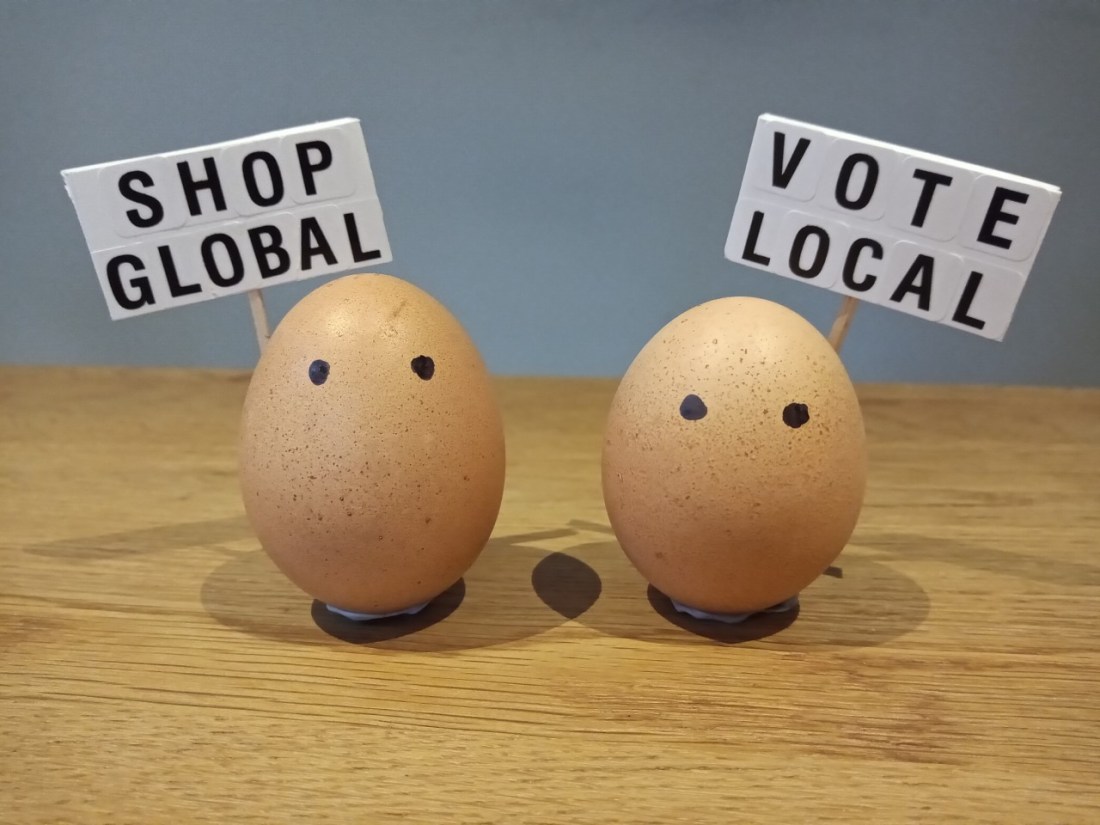
One of the catch cries of the environmental movement urges us to “think global, act local”. This slogan points to how our actions in our community can have an impact on a bigger scale. Paraphrasing this in the title of the blog refers to how the economic and political actions of some can work in opposite directions. When out shopping, we often get lured in by cheaper goods on offer thanks to globalization, while many are voting in opposition to the global economy that keeps prices down. With people being tugged in both directions, there might not be a way out.

From the consumer’s point of view, globalization has resulted in a bonanza in terms of a growing selection of goods at low prices. Everything from clothing to computers has benefited from production being coordinated on a global scale. Globalization can achieve more for less because it increases the size of the market for many businesses. In general, a larger number of goods being produced at one place will typically have lower costs. So it would be cheaper in most cases if goods can be produced in large quantities and then shipped around the world (especially if transport costs are low). This approach also means that production can be situated where it is most efficient rather than close to where the goods will be consumed.

The lower price tags for global goods means that we can buy more, but also that production for international markets is also likely to shrink. The reason being that higher levels of output acts as a spur for automation which involves more machinery and fewer workers relative to the output. Offshoring of manufacturing jobs and basic service-sector work has added to this trend within industrialized countries where the wages are higher than elsewhere. The result is that most people are global consumers to a certain extent, while fewer and fewer people provide goods for the global market.

On top of this, global jobs have increasingly become concentrated mainly in the cities, stripping many other places of high-paying work. The more the pay packets of the locals in such communities take a battering, the greater the attraction of the cheap products that globalization is good at offering up. Even though neighbourhood businesses are likely to suffer due to this, the government has little power to mitigate the impact especially as social solidarity is on the wane. It is not surprising then that many people left behind in the wake of these changes end up feeling powerless and abandoned. Not only have jobs disappeared but individuals have been left with few meaningful ways of contributing to the economy so as to earn a wage.

With the negative effects of globalization being concentrated in specific places, location has become a more important issue in politics. Many people see their own prosperity as closely tied to the economic wellbeing of their own neighbourhood. When this manifests itself in political terms, the nation state thus becomes the obvious flagpole to rally around for those on the economic backfoot. But this resurgence in patriotic sentiment has come with its own problems, and rather than providing solutions, has split society into rival camps that do little but bicker.

An obvious solution would be to get more people to “shop local” as promoted in many corners of the world. Although buying things from stores in your neighbourhood does help a bit, it matters more where the goods are produced (although lots of services are produced locally). The trend to buy locally source agricultural produce (particularly common among people in city who would tend to “vote global”) is a step up but unlikely to be substantial enough relative to the size of global economic flows.

If those who “vote local” can only afford to “shop global”, the situation seems more likely to get worse especially since the political system seems to offer little scope for improvement. Democracy would normally find a way to mediate between competing claims but the traditional split between left and right is not set up to cope with these issues. Instead, it is our politics that is also being cheapened by the division that globalization has wrought. And it is something for which we might have to pay a lot more for as the situation is only likely to deteriorate.