Taking back control (of the economy)

Voters want to rule but economic forces are not easily subdued

While the economy can often be chaotic, living with the whims of market forces is preferable to being under the sway of potentially despotic government where the whims of the leader(s) can pass judgement for best or worst. Markets have worked to spread political power more widely as money made within the economy creates the means to gain influence against traditional centres of authority. Yet, the reverse has happened as globalization has strengthened the hands of those with economic power while the ability of government to act is being eroded. With the helping hand of government being taken away, many people feel overrun and are looking for ways of fighting back against economic forces but getting back control will probably come with a nasty economic backlash.

One of the core features of capitalism is that no one is in control. The economy instead comes into being through the multitude of actions of individuals and companies in their daily transactions. Everyone involved is a small player relative to the size of the economy and so must play by its rules that are the same irrespective of who you are. Competition keeps businesses on their toes and ensures that resources are put to their optimal use and each of us get some rewards for what we contribute to the economy. For all those willing and playing by the rules, no one can be shut out or needlessly limited in their actions, and hence are free to act as they please (within the law).

What we take for granted today was a major revelation when it first took hold in a world of hereditary monarchy when the word of one person could change the law of the land and impact on the lives of many. This concentration of power was broken up with the rise of the merchant class which offered up new ways of getting wealthy other than through inheritance. Even if other sources of wealth diluted the absolute power of past sovereigns, the growing levels of prosperity that increased trading could create were attractive to rulers at the time as it enabled large armies to be amassed.

The development of manufacturing opened up further avenues to gaining wealth on a large scale for individuals from humbler backgrounds. The growth of cities and the dismantling of the older traditions continued to erode the legitimacy of the rule of monarchs. Thus, political power was dispersed into the general population from a narrow base of land owners spreading until all adults had the right to vote. Democracy as a political system is geared towards preventing the concentration of power and often comes with additional built-in mechanisms, such as checks and balances, to ensure that no one can take over.

The economy also operates in such a way that no one should be able to dominate. Multitudes of businesses offer up similar products and compete for customers in terms of price and quality so that only market forces hold sway. But circumstances can change if one company grows large enough to gain leverage which can then be used against its rivals. This amassing of economic power has been balanced with government regulation that attempts to ensure a free and open marketplace for companies to operate in so that we all benefit.

Maintaining such a level playing field for business has become more difficult with the rise of a large international market. With greater scope for companies to expand and also potentially make use of economies of scale, big business has bulked up. Add in the capacity for companies to move operations to different places and governments have struggled to reign in the corporate heavyweights. With business in the driving seat and globalization unleashing larger market forces, the economy has become less manageable. Without the oversight of government, capitalism also seemed to be less fair and not able to be controlled for the benefit of a wider range of people. On top of this, the gains from economic growth have been spread out less evenly in the West resulting in rising levels of inequality.

Such an outcome has left many people frustrated and the results has been a push within politics to “take back control”. The policies being promoted typically involves lower levels of trade and immigration as a means to promote employment within the domestic economy. While these measures seem like common sense at first glance, less movement of goods and people would result in a reversal of many of the recent gains from globalization that helped bring about lower prices and greater selection. Such an outcome would be likely as more stringent controls at the border limits businesses from boosting production to achieve greater economies of scale and restrict the extent to which people can earn to their full potential.

The worries about being thrown to and fro by the economy is a valid concern as the heft of international business rises. Previously, the emphasis had been to ensure economic growth so that people could achieve a higher standard of living. The trade-off was that livelihoods could be upended if markets shifted due to the uptake of new technology or changes in consumer behaviour and thus put people out of jobs and drive companies into bankruptcy. People would be more willing to accept any ups and downs in their own personal circumstances if the economy offers the promise of a way to get back on track. Yet, wages for many people have stagnated over the past few decades so opportunities to bounce back are limited.

People are thus faced with choices in which any gains are likely to be small but the risk of hard times remains as a genuine threat. It makes it more likely that people will focus on their own narrow concerns without much scope to think of others. And with a greater gap between the have and the have-nots, it is harder to work up the ladder to higher pay and achieve a comfortable life. Even people that are relatively well-off may be less willing to uproot their lives as the economy changes. This is because home ownership and the growing demands of bringing up children mean that more highly-paid workers are less likely to move somewhere for a better employment opportunity.

Thus, it could be argued that with further gains being tough to come by or requiring too much of a sacrifice, more and more people seem to be happier to stick with what they have rather than push for more. It might seem strange considering the constant efforts in attempting to achieve a bigger economy but the environmental movement in the 1970s resulted in the choice being made to forgo a bit of economic growth for cleaner air and water. The way in which this dilemma was resolved in the past was through the government stepping in and recalibrating the economy so as to better achieve the desired results.

The government could thus also do more to help out people struggling due to changes in the economy but such measures have not been popular with voters. Part of the concern is how such policies would impact on the functioning of the market. For example, any policies to deal with inequality could take away motivations for people to look after themselves and potentially make them a burden to society. Increased taxes, which is the main means of funding social welfare, could also sap the incentives of entrepreneurs to work hard and take risks. And, the current political climate means that people tend to frown upon any help for those that have fallen on hard times as it goes against their sense of fairness.

As such, the main political avenue for anyone feeling as if they are missing out from economic growth has been the “build a wall” option rather than the “share the wealth” alternative. The mindset being that the worst of economic forces can be shut out and people would be free to get on with their lives. Yet, such a stance tends to go against past history which suggests that closing off the country tends to end badly. The potential impact from withdrawing from the global economy would be even greater nowadays considering that trade has helped keep inflation down while also facilitating higher earnings for those working across borders.

It is therefore not immediately obvious why such protectionism has garnished so much popularity, and a number of reasons could be put forward. For starters, the measures involved such as putting up barriers to trade or to immigration seem to deliver obvious benefits in the form of less competition for jobs and more of a market for domestic goods. The expectation of relatively immediate gains makes it easy for politicians to put forth such proposals to voters with the added benefits in that no extra spending would be needed and the policies could be framed to appeal to nationalist sentiment. On top of this, higher levels of wealth may mean that people are scare of losing what they have even if that may not be much and are thus more likely to “circle the wagons” against any oncoming threats.

In contrast, higher taxes to help out those struggling is a harder sell at a time when we are expected to fend for ourselves and government cannot be trusted to get the money to those that might actually be deserving. Coming together to help people through hardship is also more difficult when globalization has resulted in more heterogenous societies in the West. The Left leaning political parties have also shifted their focus from those at the bottom of the economic ladder towards people with a cultural disadvantage.

With the Right often being dominated by populist, it might be up to the Left to develop an option that will be more palatable for voters in terms of using the gains from globalization to help out those that have been put on the backfoot. While such measures will come with a cost of potentially slower growth, the results would be far preferable to the potential economic harm that might be done if countries close themselves off from the global economy. Put another way, higher taxes might sap the momentum of capitalism but reducing the flows across borders would be like throwing economic forces into reverse.

The current manifestation of efforts to pull up the national drawbridges has been relatively mild but the supply-chain snags caused by Covid are just a taste of what could happen if globalization is pulled part. A nightmare scenario would be for future attempts to shut off from the global economy becoming more fervent as politicians decide to double-down after the initial attempts fail. With this real prospect of populist policies triggering an economic downward spiral, a slower economy where the gains continue to build up but are shared around more would be better than an economy going backwards.


Economic purgatory

With many suffering much pain for little gain, people may lose faith in the economy

A certain degree of belief is required for anything in which hardship is endured to get to an end goal. Without the conviction that short-term pain will pay off with long-term gain, people would give up at the first hurdle. The economy demands such faith in that the downs (both in terms of personal misfortune as well as economy-wide recessions) must be endured for the good of capitalism to be realised. The market economy also decides who gets how much earthly rewards with the hardworking often being blessed. But with less being shared around and people not always seen as getting their due, more and more are not willing to wait around for the land of milk and honey.

Capitalism offers up a path to the promised land – both for individuals in their own personal circumstances but also for society as a whole in terms of prosperity for all. But this route to salvation requires much toiling along the way – not to show worthiness for a glorious afterlife but as a means to reach the end goal of (economic) heaven on earth. The economy requires sacrifice even just to maintain the current standard of living and much more to reach a higher plane of wellbeing. Without continual investment, the economy would be damned to a backward slide with much of the past gains slipping away.

For capitalism to stay on track, people must be willing to take the good with the bad and to play by the rules no matter the outcome. Job cuts and businesses going bust are the price that we need to pay for the economy to grow and create more wealth. For those having to endure these trials and tribulations, it helps to keep in mind that capitalism often works to deliver up just rewards. Similar to most religions, hard work and perseverance are seen as the righteous path to be blessed. The market can be seen as a fair arbitrator treating everyone in a similar fashion without anyone being able to sidestep to salvation.

This system of payoffs worked for individuals, businesses, and even countries as a whole. Fortune looks kindly on those willing to hold off from spending everything they have to either save for a rainy day or to put money towards something that might pay off in the future. Examples of funds used in such ways include cash a person might spend on a training course or money that a business uses to buy new equipment. A country will also prosper if it can encourage more of this type of behaviour through, for example, subsidies for education or lower taxes for investment as well as the rule of law and open markets.

Such investments that rely on spending money now for rewards in the future requires the right setup so that these choices are seen as being more worthwhile. It also often depends on a past track record to ensure that people can see the benefits of acting with an eye on the future. It has helped that the capitalist economy has produced decades of solid economic growth that lifted most in the West out of poverty and is now doing the same in China and elsewhere. While the economy continues to generate more and more, biases in how this output is distributed (both within and between countries) means that there are lots of people in the West that feel as if they are missing out.

One of the reasons behind a narrower spread of economic gains is that technology is not the helping hand that it used to be for lifting up those with fewer skills. Manufacturing was a boon for labourers in terms of machinery adding to the muscle of workers, but computing, while boosting the capacity of some, has taken away the need for knowledge from many jobs. Less input from workers tends to mean lower wages, with less spending feeding through into the local economy. The growing dependence on service employment means that any hit to jobs opportunities in the neighbourhood impacts on the regional economy.

Capitalism has also become more unruly with the development of international markets and governments have struggled to bend the global economy to their will. The expansion of markets around the world has not only resulted in greater competition among companies but also countries having to fight among each other to attract the more productive bits of the global economy. The need to compete on an international scale means that governments have less scope to extract taxes or to lift the wages of the domestic workforce, leaving the populous at the whims of market forces. The ups and downs were more manageable when the economy was less international, and with this in mind, voters still expect government policies to help make their lives better (as no politician would admit their limited capacity to make a difference).

All is not lost as greater global competition and a bigger international market has resulted in further economic gains, with the increased scale of production across global markets meaning that more could be made with relatively fewer inputs, helping to drive down prices. This process also involves employing more workers where wages are cheaper as improvements to technology means that machines can do more with less-skilled operators. As such, the advantages that industrialised countries had over the rest of the world have been eroded, and more hard work (such as long-term investment in measures such as research and development as well as education) will be required to stay on top. It is as if the gap between the penance and the payoff has widened and more faith is required to stay on track.

The potential prize that awaits has also grown as the global economy drags in the best and brightest from more places and technology is more quickly diffused around the world. Yet, for a growing number of people in the West, the longer wait is proving too much of a leap of faith. The global economy has also grown more distant from many people who might get to buy cheaper goods but who also find that there is little to offer in the way of work opportunities. The immediate gains that used to be forthcoming as people saw their standards of living rise now seem much further away and others seem to be ordained for greatness.

There is also less impetus to toe the line when considering that some people seem to be thriving without having done the hard work to get there. The notion of people being able to jump the (economic) queue to get ahead tends to greatly offend our sense of justice. If the economy is beginning to act like a fickle arbitrator, people are more likely to not play by the rules. The scope for creating mischief is limited within the economic realm itself as people need to play along or else suffer the consequences.

Instead, many who are worried about the future are choosing to “act up” politically through rallying around less conventional politicians. With mainstream politics seemingly offering up little to help, radical options on the populist Left and Right have attracted more of a following. The populist politicians often offer little relief once in power but there is the concern that even more extreme versions will come into being if the situation does not improve. Shoddy and haphazard policies could be enough to see the past gains be reversed and erode away the means by which the economy can operate. Without capitalism offering up more hope for redemption, the whole economy along with everyone who is a part of it could be dragged down into damnation.

Economics in the time of excess

Economic growth is generating more but also more trouble

It is said that you can never have too much of a good thing. Yet, while more workers or funds for investment will help an economy grow, the flipside is that businesses have to be able to absorb the labour and capital that is on offer. Although it could be taken for granted in the past that more inputs could always be used to produce higher output, changes to the economy may mean that this is no longer the case. While many workers have struggled to find high-paying jobs, there are still plenty of options for those with money to invest. Despite growing frustration that wage-earners are missing out, the main cause that has brought lots of labour and capital to the market also hampers attempts to readdress the balance.

The main function of an economy is to make as much as possible from what is at hand. Along with any economic growth, more people are put to work (often in better jobs) while capital is invested so as to boost production. Both workers and investors share the resulting economic gains in the form of wages and investment returns. The development of the manufacturing sector has been one of the key drivers of economic growth due to the ideal mix of machinery (paid for by capital) and muscle (supplied by labour) in large quantities. The scope for productivity gains in the factories also meant that output could rise, with the benefits being spread throughout the economy.

There was a hidden contradiction within this setup as the trend would be for more to be produced but also for productivity gains to mean that relatively less capital and labour would be needed as output expanded. Any extra workers or investment funds could be used elsewhere as long as there was something else that people wanted to buy. On top of this, there was also a requirement that money was ready and available to be spent on the ever-expanding levels of production. And the cash has to be in the hands of those willing to go out and buy things.

Money for such purchases mostly comes from earnings of either working or investing, but wages and interest rates (which are the returns for labour and capital) have been in the doldrums. Part of the reason behind this is that as production becomes more efficient, businesses need fewer workers and less money to get going. At the same time, globalization has expanded the worldwide workforce as well as enabling more capital to flow into the financial system. The Internet has added to this trend with online companies often getting away with fewer employees as well as less buildings and equipment (that would have needed to be brought with capital).

Although both labour and capital have seen their value decline as supply has risen relative to demand, it is those investing rather than those working that seem to have come out on top. Part of the reason behind this is that capital is relatively mobile and can more easily get to where it will be able to earn more. While the Internet allows some people with specialist skills to now ply their trade on a global scale, many workers are limited by location in terms of their employment options. Money can be invested anywhere but workers tend to remained rooted within their own borders (or even the neighbourhoods where they grew up).

Another factor in the favour of capital is that wealth tends to beget more wealth, not only in terms of the individual but for society as a whole. If more surplus cash is being generated, it will often go towards bidding up the prices of financial assets such as stocks or property. More money in the system therefore benefits those who already had funds invested and this trend will continue to build on itself if the volume of investments keeps rising, especially if less capital is needed to plough into the actual economy.

Labour does not benefit in the same way from more workers as there is more of a tendency to compete amongst itself. For starters, workers tend to look for jobs within a limited geographical space that is not something that investors are restricted to when investing. Employment opportunities are often relatively fixed in the short-term so that the livelihood of workers within any region tend to operate like a zero-sum game where job gains for one person will result in losses for someone else. Any downturns will also impact more on workers who will typically have all of their eggs in a single basket when it comes to their employment, whereas capital can be diversified across a number of investments. Hence, any economic disruption will tend to have a bigger impact on labour and capital often benefits from flexibility.

Growing economies will eventually result in more jobs so workers will see benefits but only in the long term. Gains for capital tend to be more forthcoming as asset prices can see a boost from the notion that the economy will expand sometime in the future. On the other hand, labour does see any substantial fresh gains as more workers turn up in the neighbourhood. The potential short-term benefits from more workers, such as lower prices or a greater range of services on offer, pales in comparison to the likelihood of depressed wages and job losses.

The extra size that comes with economic growth has also tended to shift the balance between labour and capital as companies have beefed up in scale so as to better operate in the global market. Size often can generate higher profits as a bigger market means businesses can gain access to more customers and greater efficiencies from a large output. Shareholders benefit from the greater profitability through such means as being able to situate production where the required labour is cheapest. While capital can band together in the form of ever larger companies, workers are increasingly fractured and on the back foot.

The size of business operations also matters when it comes to influencing government policy as does a common interest in a more dynamic economy. The leverage that capital has stems from a past when it was relatively scarce compared to the many hands that could be put to work. Capital still holds its privileged position for policymakers although so little is needed nowadays to get a company set up. Yet, with “good jobs” being relatively scarce and large companies often being the most productive and thus able to offer up better wages, big business has held onto much of its ability to hold sway over government.

These trends for workers and investors do not seem likely to change anytime soon. It is the result of overwhelming economic forces involving globalization and the Internet in the face of which even governments hold little sway. Globalization, which is the cause generating lots of both capital and labour and putting the former on a stronger footing than the latter, also inhibits the political means for dealing with the potential downside. The reason for this is because increased competition between countries for the better work opportunities means that there is less scope for measures to spread the wealth. For example, policies such as higher taxes or hikes to minimum wages could be used to help alleviate hardship but would also make workers more expensive to employ.

On top of this, citizens of the same country often tend to feel less camaraderie as the economy becomes international with the accompanying rise in movement in goods and people. As yet, politics has struggled to find a balance between the mounting levels (and dominance) of capital and the growing frustration among workers. And with little help from economics which is fine-tuned to deal with getting the most out of scarce resources, how to deal with abundance is a fresh challenge that has yet to be overcome.

Breaking up (the economy) is hard to do

After manufacturing, the service sector is a bad rebound option for workers

Change happens all of the time (in a healthy economy) but sometimes it is harder to take. Amid the constant churn of companies going bust and people losing their jobs, new businesses reshaped the economy as manufacturing took over from agriculture before the service sector became the mainstay. The initial shift from farm to factory created new combinations of man and machine that, after a rough start, seemed to be like a match made in heaven with productivity gains spurring on higher wages for workers. The good times could not last forever however with fewer people needed on production lines, but service jobs have proved to be a poor replacement and have left workers wanting more.

From the Industrial Revolution to modern day China, factories have provided employment that has acted as a route to escape the drudgery of toiling on the land and to realize a better life. Yet, as much as manufacturing jobs are still prized in many places, such work has been hard to find, due in part to offshoring of production but also growing levels of automation meaning that even more goods can be made with fewer workers. The productivity gains that have enabled more to be produced with less could be seen as a success as maximizing output with limited resources is one of the primary goals of any economy.

Even though more goods can be produced at lower cost, there is a tendency for people to shift their spending to services instead as the level of wealth grows. As such, the trends of rising productivity combined with falling demand (relative to services) meant that manufacturing could only power on the economy for a limited period of time. There would inevitably be a point in which more stuff could be produced but people would rather spend their cash on something else. With the manufacturing industry needing less resources (capital and labour) to provide what consumers wanted, more inputs went into offering up a greater range of services.

Services are inherently different to manufacturing for workers with fewer skills in the extent to which the jobs typically involve less technology that boosts the capacities (and hence wages) of workers. The transition from manufacturing to services was also different in that previous cases of shifts in employment between different sectors in the economy had been driven by workers seeking higher wages. Employers in factories could pay more than what people could earn through agriculture as the use of machinery in producing goods lifted the productivity of workers.

The rise of services as the dominant employer is different in that many of the workers with lower skills are not being drawn away from manufacturing through the lure of bigger pay packets. It is more obviously the case that the lack of work opportunities in producing goods have left workers with few other options. As such, the service sector did not have to win over workers by paying them more but could attract staff even offering only low-paid work. The only competition for workers without specialist skills was between service sector companies themselves and productivity and hence wages for such workers in this sector has always been low, so that there were no economic forces to help bolster pay levels. Employers would only need to ensure that their employees were generating enough output to justify paying at least minimum wage, although the gig economy has found ways to sidestep such restrictions.

The overall impact was to not only see a decline in wages for those moving into the service sector but for the pay packets of the low skilled across the whole economy to suffer as fewer well-paid jobs eroded their bargaining power. Much of the economic hardship has been concentrated in areas where manufacturing jobs dominated as the remaining service sector work only tends to move money around the local economy rather than to draw in funds to help sustain businesses. The resulting weaker spending would also feedback into shaping what is produced for the consumer market and likely increase the likelihood of more goods and services being made with low-paid workers.

These changes have thrown up two challenges to the status quo of economic theory that have not been properly dealt with. The dismantling of large chunks of an economy is something that has never been seen before to the degree that is happening to the manufacturing industry in the West. It has been relatively easy for the large investments that were ploughed into the buildings and machinery to be written off as capital is relatively mobile and able to absorb such risks. It is the labour force that has struggle to adapt with people being left behind even as the economy moves on. Previous transitions from farm to factory involved the same movement of people but also came with the lure of higher pay and greater freedoms compared to living off the land, whereas service sector jobs tend to offer less fulfilling work at lower pay and security.

The shift to services also served up a second problem in terms of the notion of economic growth being a linear progression of the economy with relatively minor bumps along the way. Getting people to work hard in the present is easier when they expect life will be better in the future, even if it is just for their children. Yet, the breakdown in the reliable advancement of living standards over time could be translating into a weakening in the willingness to sacrifice for greater prosperity at some point down the line. With the economy not providing the wage gains and job stability as it did in the past, people are venting their frustrations through the political system which is struggling to cope.

It is as if the economy has gone through a separation in the same way that a couple might. The combination of labour and capital in manufacturing was such a boon for the economy in terms of higher wages and rising prosperity but it was also like one of the pairings that cannot last. After it was no longer feasible for workers and the machinery to stay together, what came next for wage-earners in the service sector has been a let-down and it seems unlikely that such a good match will ever show up again, thus creating frustration among workers about what has gone before.

As such, it is not the breaking up of the economy that is the problem but that what has come after offers up less for most people than in the past. If the service sector is merely a poor plan B for many workers and there is little pay going into wallets, outlays by the average consumer will be depressed and people may see little benefit from working hard. Without this virtuous cycle of striving and spending, the economy may struggle to get its mojo back and irritation will build as people think of past glories. A breakup is even harder to take when you have to worry that your best is behind you.

Unspreading the wealth

Manufacturing was about more than jobs as problems still linger

The ideal role of the economy is not only to generate wealth but to make sure that everyone gets their fair share. Spreading the cash around is important in terms of everyone having enough to get by but also for providing a source of funds that can be used to purchase what is produced in the economy. The relevance of where wages are earnt and spent seems more pertinent as the drop off in employment in manufacturing has impacted on whole regions in industrialized countries. Without the higher wages earnt from employment in the factories, not only the individual workers but whole communities suffer while economic activity shifts elsewhere.

What we think of as the economy only really took off with the rise of the manufacturing industry. Previously, most people had eked a living off the land with workers scattered across farms and toiling away in relative isolation. The rise of factories was a significant change in that it brought people together under one roof and allowed for mass production of goods that had been made by hand. Despite the often-horrendous living and working conditions in the beginning, manufacturing eventually offered a route to a better life, both in terms of providing a large volume of cheap goods but also the higher wages paid out to workers. The lure of factory jobs still draws in people from the countryside in countries that have not industrialised enough to benefit from manufacturing.

In this way, manufacturing was crucial both in terms of generating greater levels of output as well as providing money for people to spend. It was through higher factory wages that a middle class rose up to not only buy the goods rolling off the production lines but also to help create other jobs in the service sector as they spent their earnings. The boost to wages came from the use of machinery on the factory floor which set it apart from agriculture where more basic equipment had been employed. The greater use of technology meant that workers could earn more even without having to acquire any specialist knowledge for the job. The wider spread of wealth was a profound shift from how society had been set up in the past with the middle class filling the long-established gap between an impoverished majority and affluent elite.

On top of these changes, manufacturing also moved people away from their previous attachment to the land and gathered them together to work in much closer proximity. Yet the extent to which cities could grow in size was limited by the need to have essentials such as food and fuel be transported in from the surrounding farms or further afield. As such, manufacturing resulted in a larger number of towns rather than a few big cities. Even once these limits had been overcome with improvements in technology, cities often did not provide suitable location for factories which were instead more likely to be set up in places where land and wages were relatively cheap.

Manufacturing thus acted to offset the tendency for economic activity to be concentrated in cities, serving to not only distribute wealth among a wider range of individuals but also among different regions within an industrialised country. This second effect was due to the higher pay packets for factory workers acting to support a bevy of service jobs in the surrounding community. This spending from the wallets of the employees of manufacturing firms came from sales of goods beyond the immediate confines of the local community. As such, it could be argued that manufacturing brought money into the local economies where ever production was situated.

It is easy to see then that the influx of cash for spending locally would thus dry up if the factories were moved away. Any local economy needs money coming in as funds are always flowing out in the purchase of goods made elsewhere or for other things such as taxes or services not offered locally. It is often the case that the service jobs that remain tend to serve people within the community but are insufficient to sustain the existing businesses as such transactions tend to merely see money moved around the local economy.

Not all sectors within services are like this but some professional services such as finance, accounting, or law serve a wider range of clients who can be based in more far-flung places. Such businesses with their skilled workforce tend to be concentrated in a few places and provide the basis for the large cities which have flourished. The demand for such professional services has grown along with the spread of international markets and the growing complexity of global production. At the same time, a mass of jobs has been created around such global service centres which have become the new focal points for the economy.

The large metropolises may be booming now, in part because of such a role in managing the global economy but also because they are, in some ways, the “last man-standing” in terms of offering high-paid jobs. On top of this, manufacturing is unlikely to make a comeback as, just like agriculture before it, the number of jobs on offer was always likely to diminish over time. Similar to farms, factories have a workforce declining due to the rising use of machines and greater wealth causing people to spend more money on other things. Yet, while rising food prices can bring wealth (if not much employment) to the countryside, trends in manufacturing are more likely to see fewer and fewer sites for production as bigger factories are more efficient especially when goods can be transported cheaply.

Cheaper transport and communication mean that factories no longer need to be limited to places where labour and land are cheap within industrialized countries but are free to be situated anywhere. As such, the effect of manufacturing spreading the wealth, while greatly diminished in Western countries, now instead operates on a global scale. While everyone has benefited from cheaper prices thanks to lower labour costs, it is the places at which manufacturing sites have been located that have seen the most advantages as the higher wages act to lift the local economy. It is as if the jobs in services that would have provided employment in the factory towns in the West have also been offshored.

While many have moved on, these changes have left some in industrialized countries stranded as the shift towards cities offers up little in terms of job opportunities. Manufacturing provided a workplace for people with a range of skills that are different to those who might thrive in the new knowledge economy and even get by in the broader service sector. The wider dispersion of economic activity also allowed more scope for people who preferred the greater security and closer community of smaller towns to the more individualist cosmopolitan culture of city life. On top of this, such challenges would have been easier to bear when placed on the shoulders of individuals dispersed throughout society, but the concentration of people left behind by economic growth is more difficult to deal with.

Although people are deemed to be responsible for their own fortunes, this stance is more difficult to defend when it is previously prosperous regions that suffer as economic activity moves elsewhere. With more to lose in terms of both material possessions as well as a sense of identity compared with the past, many individuals have proven unable to keep up with the demands of economic change. Government policies such as “levelling up” suggest more sympathy towards communities that have fallen behind, but the scope of the problem and the relentless forces of global capitalism mean that there is little that can likely be done. Only time will tell if it is people themselves that will need to continually reshape their lives to fit with the changing economy or if more will be done to bend the economy to the will of the people.

All work and no gain

Workers may need to battle for more than just their jobs

It is one of the big truths in economic theory – there will always be plenty of jobs to go around. Even if some workplaces disappear, businesses are expected to come up with ways of putting any excess labour to good use. As long as people can earn wages and have money to spend, there will be employment options to via for this cash. But this insight was based on how the economy had been operating in the past when workers could move so as to use more technology at their new employers. With the job market increasingly offering up less scope for wage gains, more work may not be the solution.

Labour is like any other resource in the economy in that it needs to be able to move around to be put to the best use. Losing one’s job (which even the Free Range Economist has experienced) may put the individual in a tight spot but would be good for the economy as it would help get workers to where they are most needed. This process is easier for workers to stomach if there are lots of other employment options available and especially if decent wages were on offer elsewhere. Manufacturing was a bonus in this regard as workers could be made more productive compared to other forms of employment through greater use of machinery.

Yet, this trend seems to have gone into reverse as factories have been moved offshore and automation often means that workers need fewer skills and are more interchangeable. Along with the demise of manufacturing, the transition from producing stuff to offering up services has exacerbated the deterioration in job prospects with the service sector notorious for low productivity. The changes have not hurt everyone but a lucky minority have benefited through being able to provide specialist skills over a global market. As such, the productive capacity of those at the high end have shot up while work options for many other continue to dry up.

Amid these changes, the economy continues to grow with average output among workers edging upwards. Yet, stripping out the extremes in the earners of global highflyers would likely show that most workers are suffering from a tapering off in productivity (and hence wages). This trend would be worrying not only for workers shifting to jobs that are lower in pay (and likely less fulfilling) but also that there might be mechanisms at play in which a decline in the spending capacity of the bulk of consumers could make the situation worse.

Smaller pay packets for many people would see more money being spent on cheaper goods which are more likely to be mass produced with high levels of automation. Such a feedback loop could see falls in spending power bolstering businesses that pay out less in wages. The income of the middle class which had been the bulwark of the modern economy would be eroded with only a minority being able to generate higher earnings.  Even if a few high earners have even more cash to splash around, such free spending would unlikely be enough to replace the drop in incomes elsewhere.

The overall result could be a splitting of the economy to either use mass production at low costs to serve people with little to spend or provide high-value products in small batches for the affluent minority. This outcome would be markedly different to the first few decades of the postwar era when inequality was less prevalent and people would shop at the same places irrespective of their income. The current state of affairs is, in some ways, a return to the past in terms of the opening up of a large gulf within society, similar to but not as extreme as that between princes and peasants.

Economist have not raised much concern about such an eventuality as it is more the quantity of jobs rather than the quality that has been given priority. But this rationale in economic theory has been backed by the tendency for wages to rise over time which has been a feature of modern economies since workers left farms to work in factories. People could be put to use with higher levels of technology but this trend may have gone into reverse as automation picks up more of the slack in the workplace. The deteriorating prospects for workers with fewer specialist skills means that business has the upper hand in setting the rules as shown by the way in which companies can sidestep labour regulations in the gig economy.

Companies have been given the freedom to go about their business with government policies often aiming to offer support with the ultimate goal of providing people with employment. Despite business and workers often being promoted by different sides of the political spectrum, there is common interest in finding a balance in which both sides prosper. As such, any decline in the fortunes of workers will ultimately hurt their employers if lower wages feed through to drag down revenues due to the economy getting trapped in a loop whereby lower wages mean less spending.

If this trend persists, any changes in the economy will likely come with increasing levels of hardship as the loss of work will also tend to come with a pay cut. The skills required to rise up the pay scales have also become harder to come by as technology can accomplish more of the tasks required in workplaces. Making sure that everyone has a job may not be enough if workers are facing deteriorating prospects. The politics of self sufficiency and individual responsibility may become less palatable if hard work on the job no longer provides a route to prosperity. Putting in the hours will not be enough if more work does not make up for less pay.

Labouring over higher output

Full employment may no longer be working for the economy

It seems like common sense to say that more is better. As such, the main function of any economy has been to produce the most output from the resources available. One of these resources is labour, but rather than make as little use of it as possible, the objective seems to be to use as much of it as is available. Enough work needs to be created so that at least everyone that wants a job is gainfully employed. Yet the need to have everyone toiling away comes from a time when there was not enough to go around. Amid growing material abundance but limited employment options, it may be time that we gave ourselves more of a break.

Outside the garden of Eden, labouring has been a part of human existence. The primary objective of such efforts has been to provide enough for everyone to live off. Organizing the economy to produce as much as possible is a relatively recent phenomenon that developed in the West and spread elsewhere. The extra production was first put to use for nation building at a time when warfare between states in Europe was common, thus giving motivation for rulers to free up market forces so that more wealth could be created.

Greater output helped facilitate higher tax payments as well as giving funds for trade with other countries, which enabled increases in the amount and variety of goods on offer. In this way, both nation states and their citizens benefitted from a higher output. Such a mentality continues to linger within economic theory such as with the concept of GDP which is a measure of national wealth (that reflects the wealth of the whole rather than the parts). But this is not the only organizing principle for the economy – as well as maximizing output, everyone who is able must be employed in work.

The need to have all hands on deck to work would seem common sense – the more workers, the greater the output. Yet, having everyone on the job is not always compatible with generating the highest level of production. The requirement for a certain amount of labour to be employed could potentially limit the extent to which capital can be put to use. When invested in businesses such as in the form of machinery, capital is typically most productive when brought together in just a few places as larger scale operations tend to result in greater productivity. Yet, such a setup would not only require less labour but also concentrate highly-productive businesses in a small number of locations to the detriment of other places.

Such developments within the economy are beneficial to the overall output but also result in economic hardship. As such, governments often need to manage these trade-offs so as to ensure that wealth is spread out and any pockets of poverty are not left to fester. Yet, aiming for both a growing economy and jobs for everyone has proven to be a difficult challenge for most countries in the West in the face of globalization. The greater scale enabled through the global economy has unleashed market forces that can generate bigger shifts in economic activity with both positive and negative outcomes.

Along with global shifts in production, another popular target of ire is immigration. Fears of missing out on a job in the West limits the movement of people around the global economy despite the fact that shifting workers from poorer to richer countries would boost output. More of such flows of people had been permitted in the past but only came about with the prospering economies in the West (which no longer seems to be the case). As well as globalization increasing access to workers around the world, the amount of labour to be used has also increased as women have entered the workforce.

Workers not only have to compete with each other but also need to be more productive or cheaper than capital. The impact of globalization seems to have increased the supply of capital with funds flowing from around the world into the finance sectors in rich countries. The ability to be able to invest money in a growing range of ventures has also helped to keep capital mounting up. Yet, the need for business funding has tended to diminish as gains in productivity and online operations means that companies have become less capital intensive.

Greater supply along with falling demand has seen the price of capital drop off (as can be seen in persistently lower interest rates) which in turn makes it harder to maintain full employment. The economy as a whole will suffer if governments need to take policies to keep people in jobs which also reduce the use of capital (such as measures to lower trade). Workers will also struggle if wages are kept low so as to make employment of labour viable in the face of low prices for capital. Both of the trends of cheap capital and growing labour supply look set to continue, so the challenges with maintaining everyone in jobs may become more difficult.

Whether or not full employment will be possible is one issue but whether it is desirable is something else that should be thought through. While putting all pairs of hands to good use was needed in the past, output has reached levels that have allowed many people to live in relative comfort. The problem seems to have shifted from producing as much as possible to ensuring that everyone has enough. If the focus is to move away from maximizing output, the main sticking point could be how to organize the economy if not on the basis of everyone working.

One possible solution would obviously be for less people to work if they could get by without a job or with only working part-time. This option would only be available for people who have sufficient financial resources or who earn enough from limited working hours. Yet, the normal setup for well-paid office jobs does not permit workers to have much choice in terms of their own work schedule as it benefits employers to limit their options of their employees. Our economy could cope with more flexibility in terms of working arrangements as shown by the way in which most essential goods and services were still available during the Covid lockdowns.

Without much scope for even individual workers on high incomes to choose between work or leisure, changes may need to be made across the whole economy (especially since it is those on low incomes that might be working more while getting less). Currently, we receive wages relative to our contribution to the economy (well, that is the theory anyway). Without us each getting paid for doing our bit, there would be no way of gauging who should get how much, but also there would be no guarantee that enough work would be done for everyone to have enough.

One way to look at this is that even with the current economy, production is not as high as it could be. Society allows for exceptions for some people (such as students, the elderly or disabled, and parents with young children) to not work. From this point of view, greater scope for people to not work could be a potential way for the economy to operate on less labour. For example, further reductions in working hours (a long weekend or more national holidays), more funding for adult education, or earlier retirement would allow for less to be produced. Less availability of workers would mean that the use of capital could expand to make up the shortfall. Applying such measures on a country level may put their businesses at a disadvantage relative to foreign rivals, but changes within one set of borders could expand elsewhere if popular.

Cutting back on more marginal uses of labour would help to make those left in employment to be more productive. The reasoning behind this is that the remaining workers will pick up the slack left by the labour that has left the economy. The same effect happens after job cuts during recessions – productivity rises as less useful workers are dismissed. Output per worker would increase even more if more capital is used to replace any labour that is no longer used. And instead of making space for everyone to work, more resources (such as capital or training) could go towards getting more from the remaining workforce. This approach is how we deal with agricultural land – investing heavily in fertile regions while not taking a harvest from less arable areas.

What is different to our use of land and labour is that people who do not work are seen as not contributing. It was important that everyone played their part during times of scarcity which accounts for most of human history. While helpful when hunger and disease were a genuine threat, the prosperity in the West means that the bulk of people have been freed of these hardships. Rather than genuine need, the toil of many continues due to a cultural aversion to allow people to stay idle. As such, the challenge could be to find a way in which both work and not-working can be shared out fairly and in a way that the economy can still provide all that is needed. Otherwise, we will continue to labour away even though it will be more pain than gain.

Rage without the machine

The disappearance of an old foe leaves workers angry in its absence

Machines are normally portrayed as something threatening and potentially overpowering. Yet, it was only with the rise of the machines that people were able to boost their output enough for the bulk of society (in the West) to live in relative comfort. The combination of man and machine working in tandem also brought the middle class into existence, with the bounty of economic growth being shared relatively widely. Yet the forces that brought this about seems to have gone into reverse as both machines and the way we use them have changed, leaving many raging for times since passed.

The extent to what we could produce was limited in the past to what a person would achieve with the help of tools or farm animals. More could be harvested through harnessing the power of wind or water but the extent to which is could be applied was limited. It was only with the advent of engines powered by steam or petrol that output capacity really took off. It was not just individual workers toiling with their machines in isolation but coming together under one roof that raised labour to its most productive.  

Such manufacturing enterprises offered up big gains in output per worker, especially with the shift of the population from their previous existence eking a living off the land (without the use of technology). The machinery involved was simple due to both the basic level of technology as well as the reliance on workers without technical knowledge. Over time, the machinery became more complex and increasingly required specialized skills, with demand for education rising so that workers could keep up. Pay improved as output rose (and workers banded together to demand more), but machines also developed to be able to handle an increasing range of tasks.

As such, automation enables factories to produce more while keeping labour costs down. Offshoring of production provided a different route to a similar outcome but made the change seem more dramatic as factories in the West were shuttered (instead of a gradual diminishing of employment in manufacturing that would have occurred with automation). As factory jobs became increasingly scarce, more employment shifted to the service sector where the level of technology (and hence pay) is typically low. Thus, the employment prospects of workers with low levels of specialist skills suffered due to both starting at lower levels of pay with, as described below, less opportunity for advancement.  

As well as offering up higher wages for new recruits, manufacturing also allowed for workers to build up skills on the job as their knowledge of the production process expanded along with their length of employment. The production of goods would typically require a large number of different actions, and as such, the machinery would be designed with different tasks in mind. The vast division of labour into separate roles within a factory would mean that workers would develop knowledge relating to their individual sphere of work. Productivity (and hence pay) would typically rise with the length of service as more skills are learnt on-the-job.

Even in the case of workplaces in the service sector with high levels of technology (such as a logistics warehouse), the skill levels are low as machinery does much of the work. The use of software (in terms of, for example, how to fulfil an order) means that there is little scope for workers to get better at their job. It would be expected that workers could reach peak productivity within a relatively short period on the job. As well as being separated from machines, workers in the service sector also suffer from less division of labour with much of the work being similar in nature rather than specialized on separate tasks.

Any technology that is used in the service sector tends to be in the background so as to organize rather than to produce. This organization typically involves making sure that people or goods are in the right place at the right time. The limited use of technology is partly because the service sector is inherently impervious to technological improvement. Services often involve people being at the point of sale ready to act out their task when required. As such, jobs such as a waiter, teacher, or nurse would have changed but only at the margins, while the core features would remain the same.

Not only were men and machine working together in manufacturing but many people gathered in one place to work under the same roof. This higher density of workers was probably important in the formation of trade unions and demanding higher pay and better conditions. Workers in the service sector are more spread out, which, along with the limited scope for picking up skills on the job, leaves them with little leverage to get concessions from their employers. This decline in relative position is obvious in lower levels of pay for labour but also in other aspects such as shown through zero-hour contracts which gives employers more control over workers.

Not only is the predicament of service-sector workers hurting those employed in such jobs but may also be having a wider impact across the whole labour market. The lower pay for workers in service jobs also damages the job prospects of those working in other sectors of the economy as it limits the options of people to move to better jobs. Higher pay in manufacturing had been seen to boost the plight of all workers, but the switch in employment in services may be having the opposite effect.

These changes within the job market go some way to explain how employment can be high but wage gains have been weak. Even with a relatively tight labour market (such as after the Covid lockdown), increases in wages remain limited in scope (which may be in part due to an inability of employers to pass on the costs of a higher wage bill through higher prices). The shift from manufacturing to services also seems to have the effect of concentrating economic activity in larger cities with other places suffering as a result. The broad consensus regarding an open economy with free movement of goods and people was, in part, based on the economic security provided through manufacturing jobs.

Without the relative abundance of such “good jobs”, the politics of economic growth becomes more difficult. Much about politics these days is about a return to a better past, with slogans such as “take back control” and “make America great again”. These glory days of old often involve a large manufacturing sector and all of the jobs and prosperity that comes with bring with it. Yet, the economy has changed and does not work in reverse. Even attempts to keep manufacturing jobs from moving overseas is also likely to be a lost cause as machines have reached the stage when only minimal human input is necessary for a growing number of tasks. And on top of this, the impact of a few manufacturing jobs will likely be much smaller relative to when factory work was readily available.

The focus on jobs and employment (like the emphasis on economic output) hides many of the important details. It seems to be the frustration bubbling up in politics rather than the usual economic indicators that might provide a better measure for the health of the economy. Without an understanding of what lies behind the numbers, all can seem well while the reality might be that the economy is not providing prosperity as it once did. It may be discontent, rather than data, that paints a truer picture.

More carrot

Despite less need to, the motivation to work relies increasingly on the stick

No one likes to get up in the morning, least of all, the Free Range Economist. But it is seen as a good thing to have a reason to get out of bed. For most people, what rouses them from their nightly slumber is the need to go out to earn a living. Without such demands being placed on us, there is a fear that not only would the economy cease to function but that we, as individuals, would also languish. Some lucky people look forward to their job but work has become more effort and less rewarding for many. As such, it seems as if the stick (rather than the carrot) has become a more important source of motivation at a time when it should be needed less.

The need to toil away to ensure survival has been a constant throughout much all of human history. The precarious nature of life meant that (mostly) everyone had to be made to do their bit for the group to ensure their continued existence. Even children and the elderly were pressed into service to eek out every additional bit. Over time, the pressures to labour away have eased as society has become wealthier. The working day has been limited to eight hours a day for most people with two days of rest on the weekend, while children are sent to school instead of jobs with retirement beckoning after a long working life.

Not only had time devoted to work been declining but jobs also provided, along with a pay packet, a sense of purpose and social standing. Yet, while the quantity of goods being produced has increased dramatically, it could be argued that the quality of many jobs, in terms of pay and purpose, has declined. The combined forces of automation along with globalization has eroded better-paid employment that had been the foundation of the middle class. In place of such jobs in manufacturing or administration, work now offers lower pay and less security, particularly for those with less education. This trend is party because technology has tended to make many jobs either redundant or strips away the skills required. Future developments such as driverless cars and artificial intelligence are expected to push this trend even further.   

With fewer opportunities to build up skills on the job, workers have become more easily replaceable, often giving the upper hand to their employer. Companies can demand more of workers, having greater say over when and where they work while monitoring them to get more out of them while on the job. Workers have little choice but to put up with this as support from government has been weakened over the past decade. The result being that, rather than those being left behind by technological change being given a helping hand through access to retraining and other types of assistance, support in the form of welfare payments have been cut.

How we deal with both the limited options for meaningful employment depends on how we see human nature – are we all lazy if left to our own devices or can anyone prosper given a little help and encouragement? It could be argued that there are plenty of jobs going for anyone willing to work. And those that toil away are understandably unwilling to help out anyone not playing their part. People seems to be less sympathetic to those left behind now that most people are relatively comfortable (or can working towards getting there). Yet, in a society where wealth is a route to status, working for minimum wage with little prospect of improvement is not a great motivator. And the expectation that hard work now would help provide a better life for your children, which is no longer a given, is not the carrot that it once was.

It could be argued that, while the stick is occasionally necessary for motivating people, it would be preferable to use the carrot as much as possible. It is both easier and more efficient to get people to do something if they want to rather than if they feel compelled to. Also, with the current productive capacity, boosting output is less of a priority than in the past. Even with the bulk of workers asked to stay at home during the Covid lockdowns, the economy could still function to the extent of providing everyone with at least the basics.

Government policy could be used to make up for the shortfall in meaningful employment such as through increasing the minimum wage so that even the tedious but necessary jobs (that also got us through the Covid pandemic) offer up more of a reward. Worker standard could also be tightened so that employees have more leverage in defining the way in which they want to work. Without any intervention, work practices will continue as they have been, with companies under no pressure to make any changes that could offer significant improvements for workers (although working from home over lockdown could spur on some changes).

Over time, the harsher edges of the capitalist economy have been smoothed away through measures such as limits to working hours and support for the unemployed. Greater use of the stick could be seen as a backwards move but it has also occurred at a time when rising inequality (another potential downside of capitalism) has also returned. Changes such as globalization could mean that market forces may have increased in strength as business has bulked up to operate on an international scale. But political forces are likely to stand in the way as people are not likely to accept the greater demands that the economy has thrust upon them.

While older people might still remember times of hardship, the new generation of workers are more accustomed to being spurred on by a sense of purpose. Whereas the promise of material comfort might have been enough for workers in the past, many of the young have grown up in households where getting by was not a struggle. As such, more recent hires will want more from a job than a pay packet (if they are not working minimum wage) and these demands might feed through into politics. And then sticks will be used to beat the drums of change.

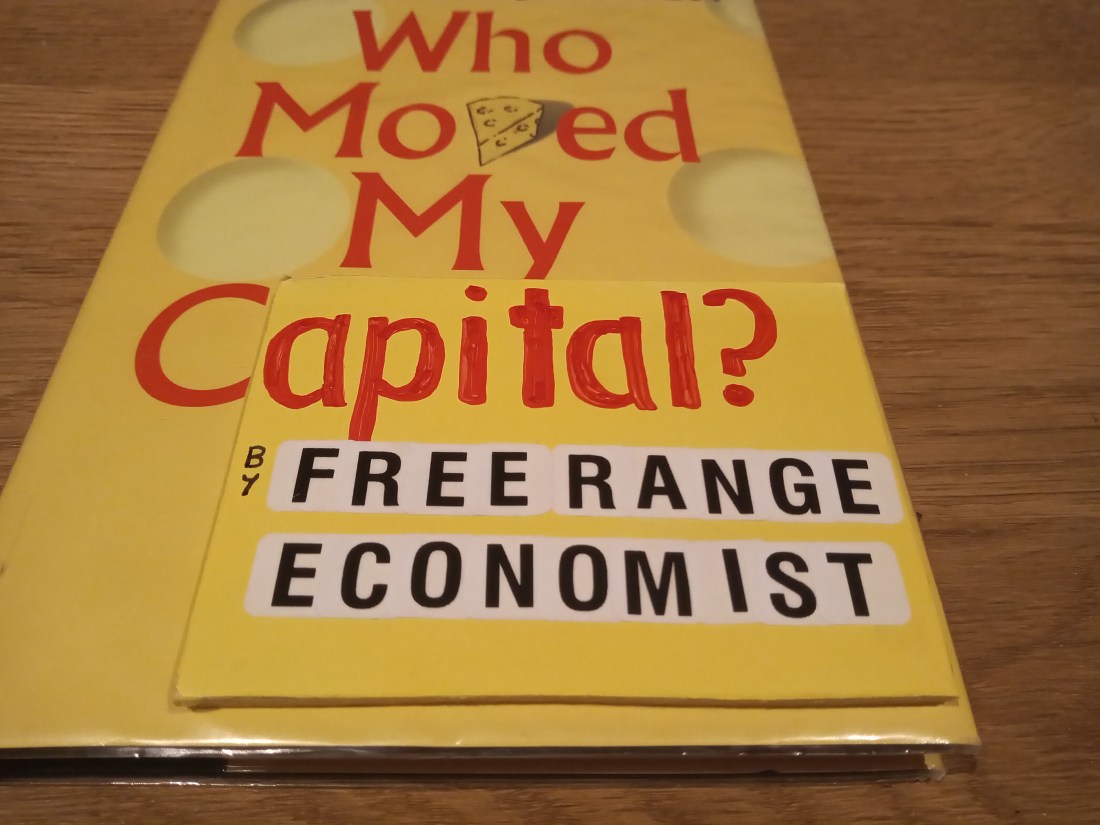
Who moved my capital?

It has become harder for some to earn a decent wage and increasingly others may struggle as well

“Who moved my cheese?” was a best-selling motivational book about how to deal with change in life. Change is something that we have all had to deal with of late amid massive shifts in the economy but it has hit some people more than others. Part of the reason for this is that many of the things needed to make us productive in the workplace have become concentrated in just a few places. It is not only those that have seen their productivity decline that should be worried as this trend might catch up with all of us.

There are two basic inputs that go into an economy, labour and capital, which are mixed together in different combinations to generate output. In this context, capital is what we use at work to help us get the job done and can include anything from a screwdriver to a computer (and even knowledge we have acquired). Improvements in technology means that capital has been able to do more of the work by either making people more productive or by doing away with the need for workers.

This development has increasingly split workers into two camps – those who work with lots of capital and those who work with very little. Part of the reason behind this is the demise of manufacturing which was a productive combination of (wo)man and machine that offered work accessible to anyone with even just a basic education. The automation or offshoring of manufacturing jobs essentially took away the tools of the workers and hence one major route to higher wages. Investment in many areas dropped away as the newer forms of technology were typically employed elsewhere.

On top of this, the economy also shifted away from producing good to managing the growing complexities involved in global production. Such work often involved handling information and required cognitive and analytical skills that required extra education. Skilled workers have thus become the main productive asset in the economy and have migrated to work in the big metropolises of the world. While good for the individuals involved, this gathering of skilled workers in a few locations has resulted in other places losing some of their best and brightest minds.

The effects of the movement of both physical and human capital are profound as the output (and hence wages) of most workers depends on who and what they work with. It therefore makes a big difference whether you do the same job for a local firm or a global multinational, whether it be your colleagues on the job or the resources (such as IT) that help you with your work. As such, people who work outside of the big cities lost access to capital in their work places, both in terms of technology but also in terms of the human capital of skilled workers.

The situation is compounded by the tendency for economic activity to follow capital. More capital at work tends to mean higher wages which can be spend on goods but a large portion is also paid out for services provided locally. So the vibrancy of the local economy typically relies on the capital that workers use at their jobs. If the, let’s call them, de-capitalized workers were spread evenly within their respective countries, their plight would not be such an issue as there would be more jobs either working with or serving the capitalized workers.

Moving the workers to follow the capital might seem like the obvious solution but it is not so simple. Having the productive assets concentrated in a few areas means that the cost of living nearby goes up. Rent and land prices have increased as the supply of housing has struggled to keep up with the influx of people. Other issues also mount up such as congestion, overcrowding on public transport, and pollution. The opposite policy of moving capital back to the people might also seem plausible, but to get the best out of skilled workers, it is increasingly important to have them all working in close proximity.

Some tinkering may help such as better transport links to connect more people with the capital. More could also be done to compensate those that have been left stranded who might otherwise use the political system to claw back lost gains. We should not just worry about what has happened but also what might happen if capital is further concentrated. The result of this would be that fewer and fewer people would be able to earn decent wages, impacting not only the individuals but the health of the economy as a whole. All the more reason to watch where capital might be moving to next.