Taking back control (of the economy)

Voters want to rule but economic forces are not easily subdued

While the economy can often be chaotic, living with the whims of market forces is preferable to being under the sway of potentially despotic government where the whims of the leader(s) can pass judgement for best or worst. Markets have worked to spread political power more widely as money made within the economy creates the means to gain influence against traditional centres of authority. Yet, the reverse has happened as globalization has strengthened the hands of those with economic power while the ability of government to act is being eroded. With the helping hand of government being taken away, many people feel overrun and are looking for ways of fighting back against economic forces but getting back control will probably come with a nasty economic backlash.

One of the core features of capitalism is that no one is in control. The economy instead comes into being through the multitude of actions of individuals and companies in their daily transactions. Everyone involved is a small player relative to the size of the economy and so must play by its rules that are the same irrespective of who you are. Competition keeps businesses on their toes and ensures that resources are put to their optimal use and each of us get some rewards for what we contribute to the economy. For all those willing and playing by the rules, no one can be shut out or needlessly limited in their actions, and hence are free to act as they please (within the law).

What we take for granted today was a major revelation when it first took hold in a world of hereditary monarchy when the word of one person could change the law of the land and impact on the lives of many. This concentration of power was broken up with the rise of the merchant class which offered up new ways of getting wealthy other than through inheritance. Even if other sources of wealth diluted the absolute power of past sovereigns, the growing levels of prosperity that increased trading could create were attractive to rulers at the time as it enabled large armies to be amassed.

The development of manufacturing opened up further avenues to gaining wealth on a large scale for individuals from humbler backgrounds. The growth of cities and the dismantling of the older traditions continued to erode the legitimacy of the rule of monarchs. Thus, political power was dispersed into the general population from a narrow base of land owners spreading until all adults had the right to vote. Democracy as a political system is geared towards preventing the concentration of power and often comes with additional built-in mechanisms, such as checks and balances, to ensure that no one can take over.

The economy also operates in such a way that no one should be able to dominate. Multitudes of businesses offer up similar products and compete for customers in terms of price and quality so that only market forces hold sway. But circumstances can change if one company grows large enough to gain leverage which can then be used against its rivals. This amassing of economic power has been balanced with government regulation that attempts to ensure a free and open marketplace for companies to operate in so that we all benefit.

Maintaining such a level playing field for business has become more difficult with the rise of a large international market. With greater scope for companies to expand and also potentially make use of economies of scale, big business has bulked up. Add in the capacity for companies to move operations to different places and governments have struggled to reign in the corporate heavyweights. With business in the driving seat and globalization unleashing larger market forces, the economy has become less manageable. Without the oversight of government, capitalism also seemed to be less fair and not able to be controlled for the benefit of a wider range of people. On top of this, the gains from economic growth have been spread out less evenly in the West resulting in rising levels of inequality.

Such an outcome has left many people frustrated and the results has been a push within politics to “take back control”. The policies being promoted typically involves lower levels of trade and immigration as a means to promote employment within the domestic economy. While these measures seem like common sense at first glance, less movement of goods and people would result in a reversal of many of the recent gains from globalization that helped bring about lower prices and greater selection. Such an outcome would be likely as more stringent controls at the border limits businesses from boosting production to achieve greater economies of scale and restrict the extent to which people can earn to their full potential.

The worries about being thrown to and fro by the economy is a valid concern as the heft of international business rises. Previously, the emphasis had been to ensure economic growth so that people could achieve a higher standard of living. The trade-off was that livelihoods could be upended if markets shifted due to the uptake of new technology or changes in consumer behaviour and thus put people out of jobs and drive companies into bankruptcy. People would be more willing to accept any ups and downs in their own personal circumstances if the economy offers the promise of a way to get back on track. Yet, wages for many people have stagnated over the past few decades so opportunities to bounce back are limited.

People are thus faced with choices in which any gains are likely to be small but the risk of hard times remains as a genuine threat. It makes it more likely that people will focus on their own narrow concerns without much scope to think of others. And with a greater gap between the have and the have-nots, it is harder to work up the ladder to higher pay and achieve a comfortable life. Even people that are relatively well-off may be less willing to uproot their lives as the economy changes. This is because home ownership and the growing demands of bringing up children mean that more highly-paid workers are less likely to move somewhere for a better employment opportunity.

Thus, it could be argued that with further gains being tough to come by or requiring too much of a sacrifice, more and more people seem to be happier to stick with what they have rather than push for more. It might seem strange considering the constant efforts in attempting to achieve a bigger economy but the environmental movement in the 1970s resulted in the choice being made to forgo a bit of economic growth for cleaner air and water. The way in which this dilemma was resolved in the past was through the government stepping in and recalibrating the economy so as to better achieve the desired results.

The government could thus also do more to help out people struggling due to changes in the economy but such measures have not been popular with voters. Part of the concern is how such policies would impact on the functioning of the market. For example, any policies to deal with inequality could take away motivations for people to look after themselves and potentially make them a burden to society. Increased taxes, which is the main means of funding social welfare, could also sap the incentives of entrepreneurs to work hard and take risks. And, the current political climate means that people tend to frown upon any help for those that have fallen on hard times as it goes against their sense of fairness.

As such, the main political avenue for anyone feeling as if they are missing out from economic growth has been the “build a wall” option rather than the “share the wealth” alternative. The mindset being that the worst of economic forces can be shut out and people would be free to get on with their lives. Yet, such a stance tends to go against past history which suggests that closing off the country tends to end badly. The potential impact from withdrawing from the global economy would be even greater nowadays considering that trade has helped keep inflation down while also facilitating higher earnings for those working across borders.

It is therefore not immediately obvious why such protectionism has garnished so much popularity, and a number of reasons could be put forward. For starters, the measures involved such as putting up barriers to trade or to immigration seem to deliver obvious benefits in the form of less competition for jobs and more of a market for domestic goods. The expectation of relatively immediate gains makes it easy for politicians to put forth such proposals to voters with the added benefits in that no extra spending would be needed and the policies could be framed to appeal to nationalist sentiment. On top of this, higher levels of wealth may mean that people are scare of losing what they have even if that may not be much and are thus more likely to “circle the wagons” against any oncoming threats.

In contrast, higher taxes to help out those struggling is a harder sell at a time when we are expected to fend for ourselves and government cannot be trusted to get the money to those that might actually be deserving. Coming together to help people through hardship is also more difficult when globalization has resulted in more heterogenous societies in the West. The Left leaning political parties have also shifted their focus from those at the bottom of the economic ladder towards people with a cultural disadvantage.

With the Right often being dominated by populist, it might be up to the Left to develop an option that will be more palatable for voters in terms of using the gains from globalization to help out those that have been put on the backfoot. While such measures will come with a cost of potentially slower growth, the results would be far preferable to the potential economic harm that might be done if countries close themselves off from the global economy. Put another way, higher taxes might sap the momentum of capitalism but reducing the flows across borders would be like throwing economic forces into reverse.

The current manifestation of efforts to pull up the national drawbridges has been relatively mild but the supply-chain snags caused by Covid are just a taste of what could happen if globalization is pulled part. A nightmare scenario would be for future attempts to shut off from the global economy becoming more fervent as politicians decide to double-down after the initial attempts fail. With this real prospect of populist policies triggering an economic downward spiral, a slower economy where the gains continue to build up but are shared around more would be better than an economy going backwards.

Economic purgatory

With many suffering much pain for little gain, people may lose faith in the economy

A certain degree of belief is required for anything in which hardship is endured to get to an end goal. Without the conviction that short-term pain will pay off with long-term gain, people would give up at the first hurdle. The economy demands such faith in that the downs (both in terms of personal misfortune as well as economy-wide recessions) must be endured for the good of capitalism to be realised. The market economy also decides who gets how much earthly rewards with the hardworking often being blessed. But with less being shared around and people not always seen as getting their due, more and more are not willing to wait around for the land of milk and honey.

Capitalism offers up a path to the promised land – both for individuals in their own personal circumstances but also for society as a whole in terms of prosperity for all. But this route to salvation requires much toiling along the way – not to show worthiness for a glorious afterlife but as a means to reach the end goal of (economic) heaven on earth. The economy requires sacrifice even just to maintain the current standard of living and much more to reach a higher plane of wellbeing. Without continual investment, the economy would be damned to a backward slide with much of the past gains slipping away.

For capitalism to stay on track, people must be willing to take the good with the bad and to play by the rules no matter the outcome. Job cuts and businesses going bust are the price that we need to pay for the economy to grow and create more wealth. For those having to endure these trials and tribulations, it helps to keep in mind that capitalism often works to deliver up just rewards. Similar to most religions, hard work and perseverance are seen as the righteous path to be blessed. The market can be seen as a fair arbitrator treating everyone in a similar fashion without anyone being able to sidestep to salvation.

This system of payoffs worked for individuals, businesses, and even countries as a whole. Fortune looks kindly on those willing to hold off from spending everything they have to either save for a rainy day or to put money towards something that might pay off in the future. Examples of funds used in such ways include cash a person might spend on a training course or money that a business uses to buy new equipment. A country will also prosper if it can encourage more of this type of behaviour through, for example, subsidies for education or lower taxes for investment as well as the rule of law and open markets.

Such investments that rely on spending money now for rewards in the future requires the right setup so that these choices are seen as being more worthwhile. It also often depends on a past track record to ensure that people can see the benefits of acting with an eye on the future. It has helped that the capitalist economy has produced decades of solid economic growth that lifted most in the West out of poverty and is now doing the same in China and elsewhere. While the economy continues to generate more and more, biases in how this output is distributed (both within and between countries) means that there are lots of people in the West that feel as if they are missing out.

One of the reasons behind a narrower spread of economic gains is that technology is not the helping hand that it used to be for lifting up those with fewer skills. Manufacturing was a boon for labourers in terms of machinery adding to the muscle of workers, but computing, while boosting the capacity of some, has taken away the need for knowledge from many jobs. Less input from workers tends to mean lower wages, with less spending feeding through into the local economy. The growing dependence on service employment means that any hit to jobs opportunities in the neighbourhood impacts on the regional economy.

Capitalism has also become more unruly with the development of international markets and governments have struggled to bend the global economy to their will. The expansion of markets around the world has not only resulted in greater competition among companies but also countries having to fight among each other to attract the more productive bits of the global economy. The need to compete on an international scale means that governments have less scope to extract taxes or to lift the wages of the domestic workforce, leaving the populous at the whims of market forces. The ups and downs were more manageable when the economy was less international, and with this in mind, voters still expect government policies to help make their lives better (as no politician would admit their limited capacity to make a difference).

All is not lost as greater global competition and a bigger international market has resulted in further economic gains, with the increased scale of production across global markets meaning that more could be made with relatively fewer inputs, helping to drive down prices. This process also involves employing more workers where wages are cheaper as improvements to technology means that machines can do more with less-skilled operators. As such, the advantages that industrialised countries had over the rest of the world have been eroded, and more hard work (such as long-term investment in measures such as research and development as well as education) will be required to stay on top. It is as if the gap between the penance and the payoff has widened and more faith is required to stay on track.

The potential prize that awaits has also grown as the global economy drags in the best and brightest from more places and technology is more quickly diffused around the world. Yet, for a growing number of people in the West, the longer wait is proving too much of a leap of faith. The global economy has also grown more distant from many people who might get to buy cheaper goods but who also find that there is little to offer in the way of work opportunities. The immediate gains that used to be forthcoming as people saw their standards of living rise now seem much further away and others seem to be ordained for greatness.

There is also less impetus to toe the line when considering that some people seem to be thriving without having done the hard work to get there. The notion of people being able to jump the (economic) queue to get ahead tends to greatly offend our sense of justice. If the economy is beginning to act like a fickle arbitrator, people are more likely to not play by the rules. The scope for creating mischief is limited within the economic realm itself as people need to play along or else suffer the consequences.

Instead, many who are worried about the future are choosing to “act up” politically through rallying around less conventional politicians. With mainstream politics seemingly offering up little to help, radical options on the populist Left and Right have attracted more of a following. The populist politicians often offer little relief once in power but there is the concern that even more extreme versions will come into being if the situation does not improve. Shoddy and haphazard policies could be enough to see the past gains be reversed and erode away the means by which the economy can operate. Without capitalism offering up more hope for redemption, the whole economy along with everyone who is a part of it could be dragged down into damnation.

Getting less from more globalization

Productivity improves as markets expand until big business weighs in

Like any athlete, the economy needs to stick to a strict regime to stay in shape. And similar to the world of sports, businesses within any healthy economy must be made to compete against each other. A growing marketplace on the back of globalization means that better-run companies have a chance to scale up while bulking up in size also adds a further impetus to productivity. Yet, these benefits may only mount up to a certain point at which big business is more likely to capture more of the gains from globalization and offer less in return.

The economy operates best when companies need to thrive on a diet of competition, whereby a large number of businesses set out their stalls to attract customers in the metaphorical marketplace. The ideal is for there to be many businesses offering similar products with anyone able to set up a new company or shut down operations. It is also optimal if customers need to come back for repeat purchases so as to be able to judge which businesses offers their favourite combination of price and quality. No company should be able to dominate as rivals are there to mop up any disappointed buyers.

An expanding marketplace is good for competition as more businesses can operate as markets grow in size, giving people a better choice of who to buy from. Companies can serve more customers as improvements to transport and communication extend their reach. Within larger markets, better-run companies can prosper at the price of other firms that get put out of business. Through this mechanism, better management practices get spread throughout the economy, resulting in more being produced without any extra effort. Such an effect will continue to add up as long as the market size is expanding and businesses are vying for customers.

Increases in size also help to make businesses more productive as operating costs can be spread over a higher volume of sales. Larger corporations are also more likely to invest in automation which boosts productivity, while also enabling individual workers to focus on a narrow range of tasks. The Internet has added further impetus in helping business to pile on extra bulk, while container ship has enabled goods to be easily moved around the world. As such, while it would have taken decades for a normal company to bulk up in size, online businesses can do it in just a few years since their reach can extend globally and they can produce goods anywhere.

For all of its potential benefits, this process of expanding the scale of the economy can only go on so far. Once the individual domestic markets are joined together into a global whole, further gains from improving business or larger scale operations are harder to come by. The issues are compounded by the forces of competition being weakened as large firms rise to dominate their separate industries. In this situation, big companies have been shown to compete less on price and quality while still generating large profits.

While technological change continues to open up avenues for potential threats, smaller companies increasingly struggle in the face of established rivals. Even if an upstart grows to a position to challenge big business, the larger companies have the financial heft to buy up the competition. Corporations also have the ability to move operations to different countries, giving them leverage to gain concessions from both workers (in the form of lower wages) as well as government (through less taxation and lighter regulation). As a result, it is big business that is reaping greater gains but it also means that others miss out on what are already diminishing returns from globalization.

This change impacts on the economy as more prolific profits tend to flow to investors who are already well off and are thus less likely to spend any extra cash. But perhaps the more serious issue is with restless populations that no longer benefit from globalization as they have done in the past. The temptation has been for populist politicians to call for the drawbridge to be pulled up and the clocks to be turned back. But the potential fragmentation of the global market threatens what has been built up and would push the whole process into reverse. The low prices of mass production would no longer be achievable if goods were to be made in more places in smaller batches. Consumers would also have less to choose from if imported goods were taken off the table.

Yet, voters seem to be flirting with this potentially harmful outcome due to a perceived lack of other options. Despite their promises, mainstream politicians seem unable to make much of a difference in terms of bending globalization more towards the will of the people. As long as someone has money to spend, what we think of as the economy will continue to tick over, so it is the realm of politics where things may potentially come to ahead. The economy is expected to at least provide hope for a better future, and without much to look forward to, it is voters that may start to throw their weight around.

Shop global, vote local

The demand for cheap goods and strong government might be too much

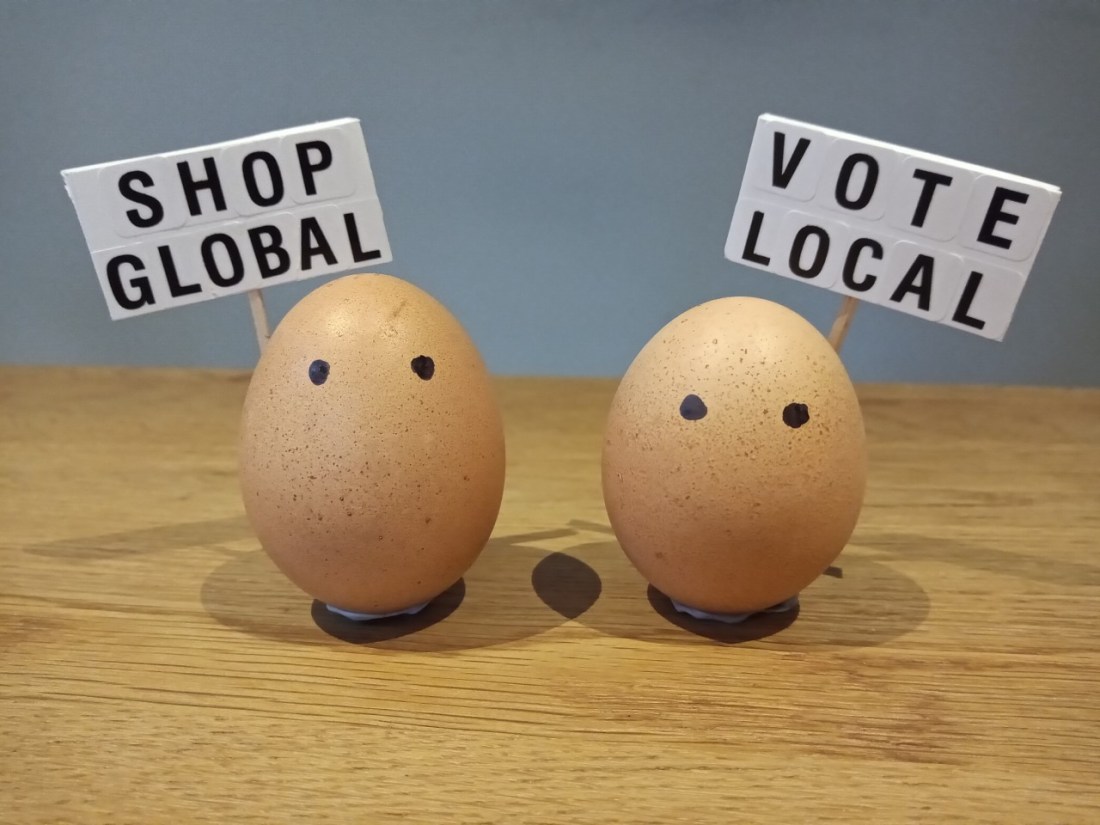
One of the catch cries of the environmental movement urges us to “think global, act local”. This slogan points to how our actions in our community can have an impact on a bigger scale. Paraphrasing this in the title of the blog refers to how the economic and political actions of some can work in opposite directions. When out shopping, we often get lured in by cheaper goods on offer thanks to globalization, while many are voting in opposition to the global economy that keeps prices down. With people being tugged in both directions, there might not be a way out.

From the consumer’s point of view, globalization has resulted in a bonanza in terms of a growing selection of goods at low prices. Everything from clothing to computers has benefited from production being coordinated on a global scale. Globalization can achieve more for less because it increases the size of the market for many businesses. In general, a larger number of goods being produced at one place will typically have lower costs. So it would be cheaper in most cases if goods can be produced in large quantities and then shipped around the world (especially if transport costs are low). This approach also means that production can be situated where it is most efficient rather than close to where the goods will be consumed.

The lower price tags for global goods means that we can buy more, but also that production for international markets is also likely to shrink. The reason being that higher levels of output acts as a spur for automation which involves more machinery and fewer workers relative to the output. Offshoring of manufacturing jobs and basic service-sector work has added to this trend within industrialized countries where the wages are higher than elsewhere. The result is that most people are global consumers to a certain extent, while fewer and fewer people provide goods for the global market.

On top of this, global jobs have increasingly become concentrated mainly in the cities, stripping many other places of high-paying work. The more the pay packets of the locals in such communities take a battering, the greater the attraction of the cheap products that globalization is good at offering up. Even though neighbourhood businesses are likely to suffer due to this, the government has little power to mitigate the impact especially as social solidarity is on the wane. It is not surprising then that many people left behind in the wake of these changes end up feeling powerless and abandoned. Not only have jobs disappeared but individuals have been left with few meaningful ways of contributing to the economy so as to earn a wage.

With the negative effects of globalization being concentrated in specific places, location has become a more important issue in politics. Many people see their own prosperity as closely tied to the economic wellbeing of their own neighbourhood. When this manifests itself in political terms, the nation state thus becomes the obvious flagpole to rally around for those on the economic backfoot. But this resurgence in patriotic sentiment has come with its own problems, and rather than providing solutions, has split society into rival camps that do little but bicker.

An obvious solution would be to get more people to “shop local” as promoted in many corners of the world. Although buying things from stores in your neighbourhood does help a bit, it matters more where the goods are produced (although lots of services are produced locally). The trend to buy locally source agricultural produce (particularly common among people in city who would tend to “vote global”) is a step up but unlikely to be substantial enough relative to the size of global economic flows.

If those who “vote local” can only afford to “shop global”, the situation seems more likely to get worse especially since the political system seems to offer little scope for improvement. Democracy would normally find a way to mediate between competing claims but the traditional split between left and right is not set up to cope with these issues. Instead, it is our politics that is also being cheapened by the division that globalization has wrought. And it is something for which we might have to pay a lot more for as the situation is only likely to deteriorate.

Capitalists of the world united

Skilled and mobile workers benefit from a united front but it cannot last forever

Karl Marx tried to kick start a revolution with the catch cry of “workers of the world unite”. But in this, as in many other things, the father of modern communism was wrong in his reading of history. Instead it is the capitalists that seem closer to unifying around a shared ethos, whereas workers around the globe seem increasingly at odds with each other. The solidarity among the well-off have put them on the front foot as they continue to grab a growing share of global output, but they are unlikely to continue to get their own way.

Capitalists of old were the owners of factories and other businesses who made their living off employing others. Ownership of the means to produce goods put them at an advantage in relation to workers who could only make a living by earning a wage. The status of labourers only improved as the level of their skills became more important to production which put them in a better position to demand higher wages and improved working conditions.

The structure of ownership changed as growing scale meant that businesses could no longer be run by individual capitalist. Instead, corporations that issued shares on financial markets took over, and everyone, whether the chairman or the cleaner, worked for such companies. The level of pay was relatively flat with even the lowest rank of workers able to earn a decent wage (but only in the industrialized countries).

Globalization broke up this relatively harmonious arrangement on two fronts. Due to an increase in the supply of (typically low-skilled) workers across the globe, the higher levels of pay for everyone in the West could no longer be sustained. Yet, skilled workers from the West were now spread thin across the entire global market and so could demand a premium for their labour. In this way, it is not what you own but what you know that has become what defines your status within the economy.

The university-educated are thus now the holders of the valuable productive assets and could be seen as the modern-day capitalists of our time. But different to the capitalist of old, their assets are often put together in combination with each other rather than by employing others with fewer skills (as a factory owner might have done). The result of this has been that skilled workers tend to work together in big cities linked to the global economy but partially separated from the rest of the national economy.

This concentration of productivity in specific locations has resulted in many losing out at the hands of globalization. Previously, manufacturing jobs might have provided a route for people with fewer skills to earn higher wages. As many of the goods produced were destined for export, manufacturing was a means to tap into the gains from globalization. This path to prosperity has been cut off with such production being shipped off to low wage countries. What was left in terms of work for low-skilled workers typically tended to be service jobs supplied to the local economy.

The result of this has been diverging interests between those benefiting from globalization and those who want the domestic economy to be given priority. The differing views have also fed through into contrasting political outlooks. Those with more skills are likely to be happy with the status quo where globalization continues to dominate, while low-skilled workers have become open to options for change. For those wanting something new, populist politicians have risen to prominence through promoting national interest against external threats.

Populist from the left and right have offered up differing approaches, while mainstream politicians struggle to come up with a suitable middle ground. Whatever the policies, the manufacturing industry in the West has continued to be eroded away. With only so many factory jobs to go around, the battle has become a zero-sum game where some workers can only benefit while others miss out. Low-skilled workers in different places are thus pitted against each other in the fight for a brighter future.

The opposite is true of the winners from globalization who are not only benefiting themselves but also tend to have opportunities open up when their peers do well. Thus, the share of the economic pie for skilled workers thus  grows as it feeds off itself. The situation is further enhanced as the high cost of living in the large prospering cities tends to shut out others. Cultural differences between city and country folk adds to the sense of separation. Residents of large metropolises often share more in common with each other, irrespective of location, rather than their countrymen and women.

The low-skilled workers share a similar plight with others in the same situation but who live in other countries. Yet, the reliance on their local economy prevents any common bonds. Their identities too are more rooted in regional traditions, making them more nationalistic in outlook. So even if the number of those left behind by globalization continue to rise, their mounting number may not translate into political strength on a global scale. Instead, they may be left at the mercy of populists, whereby any victories will come with some feel-good factor but no respite.

In this way, it is through populist and the political system that the left behind will fight back even as capitalists continue to pile up the economic gains. United as the global skilled workforce might be, they look likely to lose out as the numbers in opposition mount up in their individual countries. And then any cross-border solidarity will not amount to much if the winners from globalization cannot keep their fellow nationals on side.

Have we reached a globlock?

Growing grievances against globalization may see further progress blocked if left to fester

Globalization seems like a force of nature when considering the expanding rate at which goods circulate around the world. But globalization has also prompted resistance as some have done better than others. Trends suggest that the unequal share of gains from globalization is not likely to change and could instead become more pronounced. With discontent feeding through into the political system, it may reach a point where globalization hits up against its own built-in limits.

Both the growth and demise of globalization could stem from the notion that markets will always grow in size. Successful businesses expand as they search out new customers as well as offer up different products. This process has been given a further boost by the growing ease at which products can be transported. Goods can now be mass produced in one location and shipped across the world, providing benefits in terms of  growing economies of scale. Even online businesses such as Google and Facebook prosper as the reach of their services spreads across the globe.

The expansion of globalization has provided dividends in the form of greater efficiency, higher corporate profits, and cheaper prices. Yet, globalization has attracted increasing levels of unease in Western countries as many workers have missed out with benefits being captured by a shrinking portion of the population. The issue has been further exacerbated as the main means by which economic gains have often been shared (taxes and social spending) have been curtailed in the past few decades.

The bulk of those losing out from globalization in Western countries are made up of low-skilled workers whose jobs can be easily automated or moved elsewhere. While being pushed towards the side lines of the economy, those being left behind still have their political voice. The volume of their resentment has been turned up with the rise of populist in many countries. With their attacks on the status quo, populist threaten to derail the gains from globalization.

This begs the question of whether globalization was always likely to create resistance within democracies and thereby halt its own expansion. The bigger markets and greater levels of automation have resulted in gains that workers had made in the past being eroded away. Manufacturing had opened up a route for low-skilled workers to climb into the middle class (through exports tapping into global markets), but improvements in productivity have meant less need for workers. Transitioning people from manufacturing to the service sector has involved a drop in the level of technology on the job and hence wages.

These trends would still play out even without the economy expanding across borders. But globalization has served to act as an accelerant, both in terms of increasing the rate at which businesses could scale up in size as well as resulting in low-skilled workers (who were already set to lose out from automation) being hit even earlier due to offshoring. The international element also meant that it is the overseas rather than domestic winners from globalization who have been attracting people’s anger.

Governments have also been hampered in their response as globalization has seen its power wane relative to business. Along with their increase in size, the ease at which companies can move operations across borders has resulted in growing leverage over government policy. The resulting business-friendly policies have tended to be good for the global economy but also hampers the ability of governments to deal with the consequences of globalization within their borders.

Populists have stood up as the flag bearers for the anger against globalization as the mainstream political system offers up few solutions. The traditional left/right split in politics is ill equipped to deal with issues such as whether the economy should be more or less open. Politicians may be able to patch together a compromise, but the outlook does not look bright. Without genuine solutions to the economic pain wrought by globalization, the lure of populist will grow and may reach the point at which globalization stalls and begins to be reversed (in Western countries at least).

As much as populism is seen as wayward by those who think that they know better, it is likely to continue as a force in politics if the underlying frustrations that it feeds off remain. And the structural nature of the issues to do with both globalization and the political system means that they will not go away anytime soon. Without any solution in sight, globalization may be stopped in its tracks by, for want of a better term, a democratic globlock. Without enough winners from globalization, we might all lose out.