Getting less from more globalization

Productivity improves as markets expand until big business weighs in

Like any athlete, the economy needs to stick to a strict regime to stay in shape. And similar to the world of sports, businesses within any healthy economy must be made to compete against each other. A growing marketplace on the back of globalization means that better-run companies have a chance to scale up while bulking up in size also adds a further impetus to productivity. Yet, these benefits may only mount up to a certain point at which big business is more likely to capture more of the gains from globalization and offer less in return.

The economy operates best when companies need to thrive on a diet of competition, whereby a large number of businesses set out their stalls to attract customers in the metaphorical marketplace. The ideal is for there to be many businesses offering similar products with anyone able to set up a new company or shut down operations. It is also optimal if customers need to come back for repeat purchases so as to be able to judge which businesses offers their favourite combination of price and quality. No company should be able to dominate as rivals are there to mop up any disappointed buyers.

An expanding marketplace is good for competition as more businesses can operate as markets grow in size, giving people a better choice of who to buy from. Companies can serve more customers as improvements to transport and communication extend their reach. Within larger markets, better-run companies can prosper at the price of other firms that get put out of business. Through this mechanism, better management practices get spread throughout the economy, resulting in more being produced without any extra effort. Such an effect will continue to add up as long as the market size is expanding and businesses are vying for customers.

Increases in size also help to make businesses more productive as operating costs can be spread over a higher volume of sales. Larger corporations are also more likely to invest in automation which boosts productivity, while also enabling individual workers to focus on a narrow range of tasks. The Internet has added further impetus in helping business to pile on extra bulk, while container ship has enabled goods to be easily moved around the world. As such, while it would have taken decades for a normal company to bulk up in size, online businesses can do it in just a few years since their reach can extend globally and they can produce goods anywhere.

For all of its potential benefits, this process of expanding the scale of the economy can only go on so far. Once the individual domestic markets are joined together into a global whole, further gains from improving business or larger scale operations are harder to come by. The issues are compounded by the forces of competition being weakened as large firms rise to dominate their separate industries. In this situation, big companies have been shown to compete less on price and quality while still generating large profits.

While technological change continues to open up avenues for potential threats, smaller companies increasingly struggle in the face of established rivals. Even if an upstart grows to a position to challenge big business, the larger companies have the financial heft to buy up the competition. Corporations also have the ability to move operations to different countries, giving them leverage to gain concessions from both workers (in the form of lower wages) as well as government (through less taxation and lighter regulation). As a result, it is big business that is reaping greater gains but it also means that others miss out on what are already diminishing returns from globalization.

This change impacts on the economy as more prolific profits tend to flow to investors who are already well off and are thus less likely to spend any extra cash. But perhaps the more serious issue is with restless populations that no longer benefit from globalization as they have done in the past. The temptation has been for populist politicians to call for the drawbridge to be pulled up and the clocks to be turned back. But the potential fragmentation of the global market threatens what has been built up and would push the whole process into reverse. The low prices of mass production would no longer be achievable if goods were to be made in more places in smaller batches. Consumers would also have less to choose from if imported goods were taken off the table.

Yet, voters seem to be flirting with this potentially harmful outcome due to a perceived lack of other options. Despite their promises, mainstream politicians seem unable to make much of a difference in terms of bending globalization more towards the will of the people. As long as someone has money to spend, what we think of as the economy will continue to tick over, so it is the realm of politics where things may potentially come to ahead. The economy is expected to at least provide hope for a better future, and without much to look forward to, it is voters that may start to throw their weight around.


Labouring over higher output

Full employment may no longer be working for the economy

It seems like common sense to say that more is better. As such, the main function of any economy has been to produce the most output from the resources available. One of these resources is labour, but rather than make as little use of it as possible, the objective seems to be to use as much of it as is available. Enough work needs to be created so that at least everyone that wants a job is gainfully employed. Yet the need to have everyone toiling away comes from a time when there was not enough to go around. Amid growing material abundance but limited employment options, it may be time that we gave ourselves more of a break.

Outside the garden of Eden, labouring has been a part of human existence. The primary objective of such efforts has been to provide enough for everyone to live off. Organizing the economy to produce as much as possible is a relatively recent phenomenon that developed in the West and spread elsewhere. The extra production was first put to use for nation building at a time when warfare between states in Europe was common, thus giving motivation for rulers to free up market forces so that more wealth could be created.

Greater output helped facilitate higher tax payments as well as giving funds for trade with other countries, which enabled increases in the amount and variety of goods on offer. In this way, both nation states and their citizens benefitted from a higher output. Such a mentality continues to linger within economic theory such as with the concept of GDP which is a measure of national wealth (that reflects the wealth of the whole rather than the parts). But this is not the only organizing principle for the economy – as well as maximizing output, everyone who is able must be employed in work.

The need to have all hands on deck to work would seem common sense – the more workers, the greater the output. Yet, having everyone on the job is not always compatible with generating the highest level of production. The requirement for a certain amount of labour to be employed could potentially limit the extent to which capital can be put to use. When invested in businesses such as in the form of machinery, capital is typically most productive when brought together in just a few places as larger scale operations tend to result in greater productivity. Yet, such a setup would not only require less labour but also concentrate highly-productive businesses in a small number of locations to the detriment of other places.

Such developments within the economy are beneficial to the overall output but also result in economic hardship. As such, governments often need to manage these trade-offs so as to ensure that wealth is spread out and any pockets of poverty are not left to fester. Yet, aiming for both a growing economy and jobs for everyone has proven to be a difficult challenge for most countries in the West in the face of globalization. The greater scale enabled through the global economy has unleashed market forces that can generate bigger shifts in economic activity with both positive and negative outcomes.

Along with global shifts in production, another popular target of ire is immigration. Fears of missing out on a job in the West limits the movement of people around the global economy despite the fact that shifting workers from poorer to richer countries would boost output. More of such flows of people had been permitted in the past but only came about with the prospering economies in the West (which no longer seems to be the case). As well as globalization increasing access to workers around the world, the amount of labour to be used has also increased as women have entered the workforce.

Workers not only have to compete with each other but also need to be more productive or cheaper than capital. The impact of globalization seems to have increased the supply of capital with funds flowing from around the world into the finance sectors in rich countries. The ability to be able to invest money in a growing range of ventures has also helped to keep capital mounting up. Yet, the need for business funding has tended to diminish as gains in productivity and online operations means that companies have become less capital intensive.

Greater supply along with falling demand has seen the price of capital drop off (as can be seen in persistently lower interest rates) which in turn makes it harder to maintain full employment. The economy as a whole will suffer if governments need to take policies to keep people in jobs which also reduce the use of capital (such as measures to lower trade). Workers will also struggle if wages are kept low so as to make employment of labour viable in the face of low prices for capital. Both of the trends of cheap capital and growing labour supply look set to continue, so the challenges with maintaining everyone in jobs may become more difficult.

Whether or not full employment will be possible is one issue but whether it is desirable is something else that should be thought through. While putting all pairs of hands to good use was needed in the past, output has reached levels that have allowed many people to live in relative comfort. The problem seems to have shifted from producing as much as possible to ensuring that everyone has enough. If the focus is to move away from maximizing output, the main sticking point could be how to organize the economy if not on the basis of everyone working.

One possible solution would obviously be for less people to work if they could get by without a job or with only working part-time. This option would only be available for people who have sufficient financial resources or who earn enough from limited working hours. Yet, the normal setup for well-paid office jobs does not permit workers to have much choice in terms of their own work schedule as it benefits employers to limit their options of their employees. Our economy could cope with more flexibility in terms of working arrangements as shown by the way in which most essential goods and services were still available during the Covid lockdowns.

Without much scope for even individual workers on high incomes to choose between work or leisure, changes may need to be made across the whole economy (especially since it is those on low incomes that might be working more while getting less). Currently, we receive wages relative to our contribution to the economy (well, that is the theory anyway). Without us each getting paid for doing our bit, there would be no way of gauging who should get how much, but also there would be no guarantee that enough work would be done for everyone to have enough.

One way to look at this is that even with the current economy, production is not as high as it could be. Society allows for exceptions for some people (such as students, the elderly or disabled, and parents with young children) to not work. From this point of view, greater scope for people to not work could be a potential way for the economy to operate on less labour. For example, further reductions in working hours (a long weekend or more national holidays), more funding for adult education, or earlier retirement would allow for less to be produced. Less availability of workers would mean that the use of capital could expand to make up the shortfall. Applying such measures on a country level may put their businesses at a disadvantage relative to foreign rivals, but changes within one set of borders could expand elsewhere if popular.

Cutting back on more marginal uses of labour would help to make those left in employment to be more productive. The reasoning behind this is that the remaining workers will pick up the slack left by the labour that has left the economy. The same effect happens after job cuts during recessions – productivity rises as less useful workers are dismissed. Output per worker would increase even more if more capital is used to replace any labour that is no longer used. And instead of making space for everyone to work, more resources (such as capital or training) could go towards getting more from the remaining workforce. This approach is how we deal with agricultural land – investing heavily in fertile regions while not taking a harvest from less arable areas.

What is different to our use of land and labour is that people who do not work are seen as not contributing. It was important that everyone played their part during times of scarcity which accounts for most of human history. While helpful when hunger and disease were a genuine threat, the prosperity in the West means that the bulk of people have been freed of these hardships. Rather than genuine need, the toil of many continues due to a cultural aversion to allow people to stay idle. As such, the challenge could be to find a way in which both work and not-working can be shared out fairly and in a way that the economy can still provide all that is needed. Otherwise, we will continue to labour away even though it will be more pain than gain.

Mutating (economic) disease

Just like Covid, economic ailments could be mutating into something worse

With Covid so prevalent, most people have sickness at the front of their minds. Within economic theory, there are also ailments that get economists thinking One in particular, Baumol’s cost disease, points out why wages in sectors with low productivity can rise even though the theory suggests that productivity gains are needed for this to happen. Yet, just like Covid, this illness may have also mutated into something different and perhaps more malignant.

The economic malady in question is named after William Baumol who wrote in the 1960s about rising wages in jobs where there have been no improvements to boost output of workers. Being paid more for producing no extra goes against the basic notions of economic theory which argued that workers are paid relative to their output. Baumol used the clever example of a string quartet which still took the same number of musicians and the same amount of time as it had always done (hence no increase in productivity) and yet the pay for a performance had increased.

The reasoning he gave to explain this was that the parts of the economy that did experience gains in productivity were pushing up wages across the whole economy. If pay were to only increase in the sectors in which productivity was improving, then the higher wages would attract workers from elsewhere. So, to retain their workforce, employers in the sectors without any improvements would need to pay more for their labour costs and increase the prices that they would charge their customers.

The result of wide-spread pay increases with only partial productivity gains was that the relative cost of goods from low-productivity sectors became more expensive relative to goods produced by more productive workers. The typical manifestation of this change in relative prices is the increasing cost of services relative to goods. The manufacturing sector continues to make products cheaper and cheaper as technology allows more to be produced with less labour. On the other hand, people often need to be present for any service to be offered and hence each person can only do a limited amount of work.

The most obvious examples of Baumol’s cost disease are the rising amount of money spent on education and health care. In most cases, teachers and doctors are required to be in the same room as students or patients to do their job. Covid has resulted in much of this work being done remotely, but health and learning has suffered as a result. There has been some technological improvement in these sectors, with university courses being offered online and lots of new-fangled equipment to fix us when we are sick. Yet, we still expect teachers in the classrooms and doctors at the hospital whenever we are there.

This trend means that the economy increasingly becomes geared towards the service sector as employment in manufacturing falls. There also seems to be greater demand for services such as entertainment and travel as our general level of income increases. But the flipside of this is that it is increasingly difficult to generate gains in productivity when more and more people are employed in the service sector. Slower wage gains also mean that the amount of money we have to spend is also rising less than in the past.

It could even be the case that the shift to greater employment in services has acted as a damper on wages not only among those specific service-sector workers but across the whole economy. Just as gains in productivity in some sectors had lifted wages everywhere else, the opposite could now be true. That is, stagnating productivity in most jobs acts to depress wages for all workers. One piece of evidence for this is how much of the gains in productivity have not fed through into higher wages since the 1970s.

The shifts in employment may have pushed the economy passed a tipping point to where wages no longer rose if per-worker output increased. So instead of a cost disease pushing up the wage bill for all companies, the effect might have flipped to instead be something that could be labelled as “Baumol’s wage disease” involving low wages irrespective of productivity. The original idea of Baumol may have just been relevant to the labour market at a time of abundant manufacturing jobs.

The “wage disease” may have set in with relative scarcity of high productivity jobs dissipating the need to compete for workers through offering higher wages. Manufacturing work may have also allowed workers to build up skills on the job, making them more productive and difficult to replace. On the other hand, employees could be seen as being more interchangeable with less chances to develop skills in the expanding service sectors such as workers in Amazon warehouses or drivers for Uber.

As with Covid, we can only treat a disease once we know what it is. Yet, the predominance of low-wage work typically just prompts calls for more education and “better jobs”. As well as being a misdiagnosis of the problem, technology is already making both of these measures increasingly redundant. We instead need to figure out a way of making work pay more, not only for the sake of the individual workers themselves but also for the economy as a whole. Without bigger pay packets, the “wage disease” will result in sickly levels of spending and leave the economy in an afflicted state.

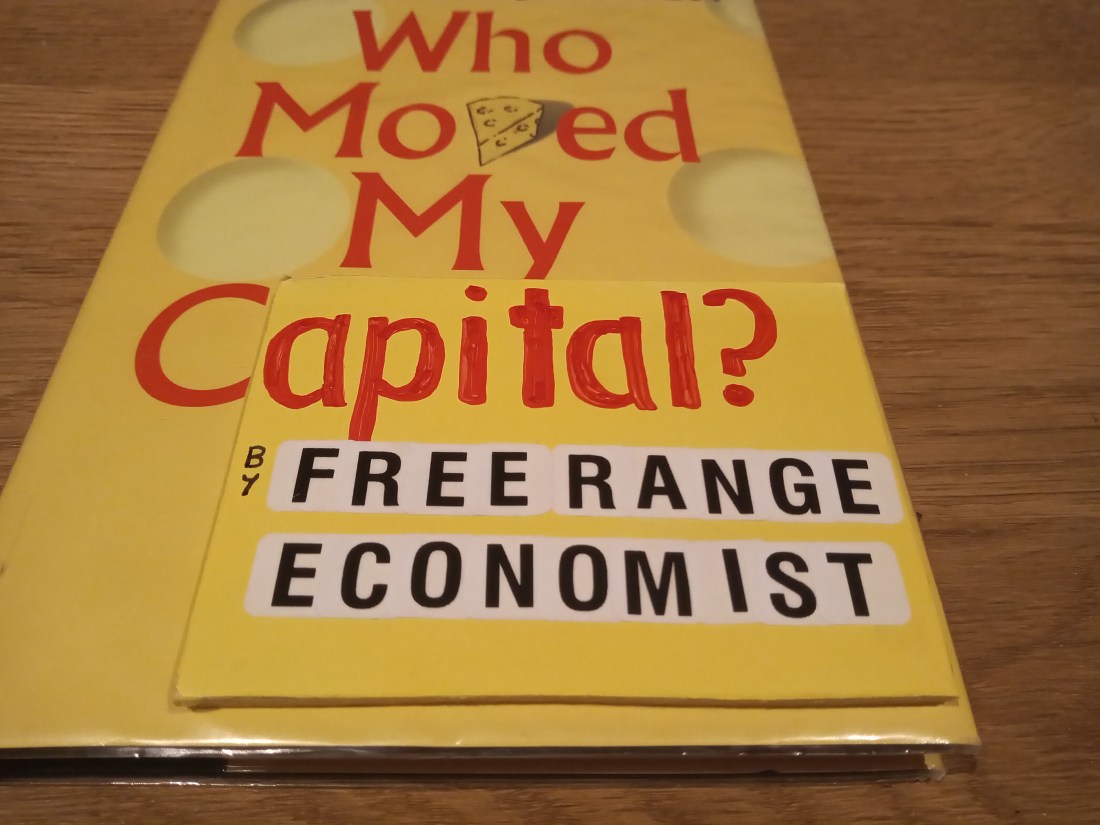
Who moved my capital?

It has become harder for some to earn a decent wage and increasingly others may struggle as well

“Who moved my cheese?” was a best-selling motivational book about how to deal with change in life. Change is something that we have all had to deal with of late amid massive shifts in the economy but it has hit some people more than others. Part of the reason for this is that many of the things needed to make us productive in the workplace have become concentrated in just a few places. It is not only those that have seen their productivity decline that should be worried as this trend might catch up with all of us.

There are two basic inputs that go into an economy, labour and capital, which are mixed together in different combinations to generate output. In this context, capital is what we use at work to help us get the job done and can include anything from a screwdriver to a computer (and even knowledge we have acquired). Improvements in technology means that capital has been able to do more of the work by either making people more productive or by doing away with the need for workers.

This development has increasingly split workers into two camps – those who work with lots of capital and those who work with very little. Part of the reason behind this is the demise of manufacturing which was a productive combination of (wo)man and machine that offered work accessible to anyone with even just a basic education. The automation or offshoring of manufacturing jobs essentially took away the tools of the workers and hence one major route to higher wages. Investment in many areas dropped away as the newer forms of technology were typically employed elsewhere.

On top of this, the economy also shifted away from producing good to managing the growing complexities involved in global production. Such work often involved handling information and required cognitive and analytical skills that required extra education. Skilled workers have thus become the main productive asset in the economy and have migrated to work in the big metropolises of the world. While good for the individuals involved, this gathering of skilled workers in a few locations has resulted in other places losing some of their best and brightest minds.

The effects of the movement of both physical and human capital are profound as the output (and hence wages) of most workers depends on who and what they work with. It therefore makes a big difference whether you do the same job for a local firm or a global multinational, whether it be your colleagues on the job or the resources (such as IT) that help you with your work. As such, people who work outside of the big cities lost access to capital in their work places, both in terms of technology but also in terms of the human capital of skilled workers.

The situation is compounded by the tendency for economic activity to follow capital. More capital at work tends to mean higher wages which can be spend on goods but a large portion is also paid out for services provided locally. So the vibrancy of the local economy typically relies on the capital that workers use at their jobs. If the, let’s call them, de-capitalized workers were spread evenly within their respective countries, their plight would not be such an issue as there would be more jobs either working with or serving the capitalized workers.

Moving the workers to follow the capital might seem like the obvious solution but it is not so simple. Having the productive assets concentrated in a few areas means that the cost of living nearby goes up. Rent and land prices have increased as the supply of housing has struggled to keep up with the influx of people. Other issues also mount up such as congestion, overcrowding on public transport, and pollution. The opposite policy of moving capital back to the people might also seem plausible, but to get the best out of skilled workers, it is increasingly important to have them all working in close proximity.

Some tinkering may help such as better transport links to connect more people with the capital. More could also be done to compensate those that have been left stranded who might otherwise use the political system to claw back lost gains. We should not just worry about what has happened but also what might happen if capital is further concentrated. The result of this would be that fewer and fewer people would be able to earn decent wages, impacting not only the individuals but the health of the economy as a whole. All the more reason to watch where capital might be moving to next.