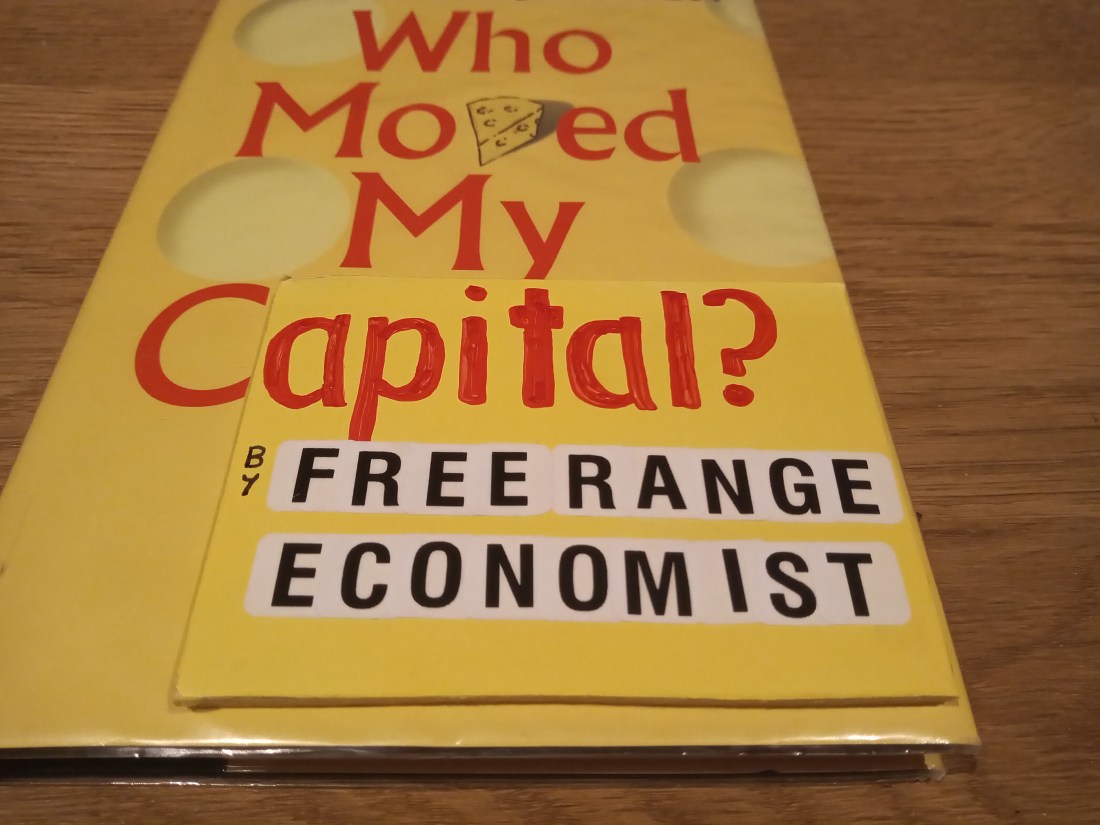
Who moved my capital?

It has become harder for some to earn a decent wage and increasingly others may struggle as well

“Who moved my cheese?” was a best-selling motivational book about how to deal with change in life. Change is something that we have all had to deal with of late amid massive shifts in the economy but it has hit some people more than others. Part of the reason for this is that many of the things needed to make us productive in the workplace have become concentrated in just a few places. It is not only those that have seen their productivity decline that should be worried as this trend might catch up with all of us.

There are two basic inputs that go into an economy, labour and capital, which are mixed together in different combinations to generate output. In this context, capital is what we use at work to help us get the job done and can include anything from a screwdriver to a computer (and even knowledge we have acquired). Improvements in technology means that capital has been able to do more of the work by either making people more productive or by doing away with the need for workers.

This development has increasingly split workers into two camps – those who work with lots of capital and those who work with very little. Part of the reason behind this is the demise of manufacturing which was a productive combination of (wo)man and machine that offered work accessible to anyone with even just a basic education. The automation or offshoring of manufacturing jobs essentially took away the tools of the workers and hence one major route to higher wages. Investment in many areas dropped away as the newer forms of technology were typically employed elsewhere.

On top of this, the economy also shifted away from producing good to managing the growing complexities involved in global production. Such work often involved handling information and required cognitive and analytical skills that required extra education. Skilled workers have thus become the main productive asset in the economy and have migrated to work in the big metropolises of the world. While good for the individuals involved, this gathering of skilled workers in a few locations has resulted in other places losing some of their best and brightest minds.

The effects of the movement of both physical and human capital are profound as the output (and hence wages) of most workers depends on who and what they work with. It therefore makes a big difference whether you do the same job for a local firm or a global multinational, whether it be your colleagues on the job or the resources (such as IT) that help you with your work. As such, people who work outside of the big cities lost access to capital in their work places, both in terms of technology but also in terms of the human capital of skilled workers.

The situation is compounded by the tendency for economic activity to follow capital. More capital at work tends to mean higher wages which can be spend on goods but a large portion is also paid out for services provided locally. So the vibrancy of the local economy typically relies on the capital that workers use at their jobs. If the, let’s call them, de-capitalized workers were spread evenly within their respective countries, their plight would not be such an issue as there would be more jobs either working with or serving the capitalized workers.

Moving the workers to follow the capital might seem like the obvious solution but it is not so simple. Having the productive assets concentrated in a few areas means that the cost of living nearby goes up. Rent and land prices have increased as the supply of housing has struggled to keep up with the influx of people. Other issues also mount up such as congestion, overcrowding on public transport, and pollution. The opposite policy of moving capital back to the people might also seem plausible, but to get the best out of skilled workers, it is increasingly important to have them all working in close proximity.

Some tinkering may help such as better transport links to connect more people with the capital. More could also be done to compensate those that have been left stranded who might otherwise use the political system to claw back lost gains. We should not just worry about what has happened but also what might happen if capital is further concentrated. The result of this would be that fewer and fewer people would be able to earn decent wages, impacting not only the individuals but the health of the economy as a whole. All the more reason to watch where capital might be moving to next.


Computing the Future of Work

Computers are changing our jobs but this new technology will not work out for all of us

It seems as if computers have changed everything. Some of the biggest changes have been at the workplace, as we move from a world in which we gathered together to operate machinery in factories, to sitting in the office (or elsewhere) tapping away on computers by ourselves. The effects of this go beyond what we do at work to also impact to how much we might be paid and where we might work. While a positive for many, these developments will not bring about a brighter future for everyone.

For starters, computers have changed the things that we produce on the job. Rather than physical objects that are produced, unit by unit, at one specific location, work on computers tend to be easy replicated and can be made available anywhere. These characteristics mean that output from computers has the potential to be more valuable as it can be easily delivered to multiple potential customers. One of the results of this is that workers will, in general, be paid more for work done in a digital format.

Along with the output being less about the physical, work with computers itself is also less physical. Traditional jobs in agriculture or manufacturing relied on a certain amount of physical strength and dexterity, and the machinery involves in these jobs were a complement these types of tasks. Computers, on the other hand, act as an aid to mental tasks, requiring different skills and also favouring some type of workers over others. Computer, in the same manner as every other new technology, produces benefits for society that are not even shard out.

Another difference to the past is how much computers also free up workers to realise more of their individual talents. This is because work itself is more individualistic in nature. Work is just one among many activities, which we would have done in the company with others, such as watching TV, are now done on our own. Whether working in the fields or in a factory, we have, in the past, relied on the help of others to get the job done. As much as office workers might email or message other, much of the work itself is carried out by one person using one computer.

The ease of using computer to share output means that people can increasing focus of niche tasks. Increasing the degree of specialization (focusing on specific roles) is a common means to boost productivity and some of these gains can be captured by the workers in terms of higher wages.  Previously, workers would have to gather in one location and share out different tasks to capture the productivity improvements of specialization. But now computers mean that individual tasks can be parcelled out to workers irrespective of their location. Digital work can then be produced across a global production line on a scale far bigger than even the largest factories.

As is the case with any economic change, the benefits are not spread out evenly. One reason for this is that mental abilities are likely to vary more than physical performance. Differences in physical attributes were normally not sufficient to generate wide variation in the value of labour. A stronger person could manage more work, but the extra labour was not valued enough to result in significant differences in wages. As computers extend cognitive capacities, existing differences balloon into vastly difference outcomes at the workplace. As a result, the smart can become rich in a way that the strong never could.  Add in the other features of more valuable output, less dependence on others, and greater specialization means that talented individuals have the potential to earn vastly more than others.

Not only do computers open up the earnings potential of the clever, computers also seem to limit the skills of other workers. This is because the ease with which computers can be used have resulted in many tasks being simplified. Previously, jobs would allow workers to build up skills that would feed through into greater productivity and higher wages. For example, working in a factory would involve operating machinery that took time to master. Computers, on the other hand, increase output without the need for workers to build up skills. By being so easy to use, it is as if the technology is hidden away so that workers themselves miss out benefiting from the productivity gains.

The simplified nature of work means that the workers themselves can be easily interchanged. Think of those working on a cash register in a supermarket which has long been computerised with scanners and barcodes. The task has become so simplified that even the customers are now doing it themselves. Even the computers themselves are unimportant and are replaced every few years. In this way, economic change is becoming even more daunting as both technology at work and skills we build up on the job can be made worthless with a time frame of a few years.

All technological advancements involve winners and losers. The big difference is that those already at an advantage are benefiting even more with the less well-off likely to struggle. There is unlikely to be any respite as further technological developments such as AI will erode the value of computer work itself. As with automation in manufacturing, computing technology will increasingly eliminate the simpler tasks. Amid these developments, education will obviously take on greater importance but the rapid pace of change mean that many will fall behind. And, what will happen when computers are smarter than us at everything?

Mind the (Technology) Gap

As technology disappears from the workplace of many people, we may end up missing the machines

Machines often play the role of the bad guy, whether in the movies or in the way in which we think the economy works. Machines, whether robots or computers, are responsible for many jobs becoming obsolete, but we would struggle to make much of our labour without their help. Technology on the job takes on extra importance for those workers who have fewer skills to start with, as their labour requires more help to earn a decent wage. Without the manufacturing sector to provide the low-skilled access to technology in their jobs, we may run the risk of having a large chunk out workforce being left behind.

To earn a good wage, a worker needs to be involved in generating as much output as possible. Doing this with just our own labour is difficult except for the most talented among us. Rather we often need to work as part of a team or with the help of some form of automation. An example of this is how it is easier to grow food on a larger scale with the help of farm machinery rather than each of us trying to do it by ourselves. Whether we work in a factory with machinery or in an office with computers, we produce more when working with others and with machines.

The origins of our modern-day prosperity came with the rise of the machines with the Industrial Revolution. Despite the initial dismal conditions for workers, employment in factories allowed wealth built up as people moved away from eking out a living from the land to gathering together under one roof to make use of the power of machines. Wages for worker rose as the machines became more complicated and required increasingly levels of skills to operate. The rising level of output and the skills built up on the job helped to ensure rising wages for those working in the manufacturing sector and help bring about the middle class.

Yet, further developments of technology meant that the machinery became automated and workers were less necessary. Globalization accelerated the demise of manufacturing in Western, making the change even more dramatic. What made the loss of the manufacturing jobs hurt was the fall in wages as workers looked for jobs elsewhere. This was due, in part, to the tendency for a drop in the level of technology and smaller work teams in the service sector which was the source of new jobs.

Jobs that might be available to those without university education would be in retail, restaurants, transport, and personal services (such as haircuts or retail estate agents). The level of technology for many of these jobs has not changed significantly for more than fifty years. And the scale of operation, in terms of the number of people at the same workplace, is a lot smaller. Think of the buildings that might house a factory compared to a cafe or a barber. Even if supermarkets or warehouses take up a lot of space, the number of machines that workers use is a lot less than would be the case in manufacturing.

This is not to downplay the impact of computers and the Internet which are in many ways even more powerful machines that were ever used in manufacturing. Yet, these “machines” are often separate from the jobs of workers, or are made so simple to operate that workers can easily pick up any task. For example, electronic cash registers and bar codes are a key technological advancement in the retail industry, but are also so simple that even supermarket shoppers themselves can do the job. In this way, service sector workers cannot build up the same levels of what economists call “human capital” which is a crucial determinant of higher wages.

Without some help to make them more productive, a big chunk of workers looks likely to be stuck on low wages. Going back in time may be plausible in the movies but not in terms of reverting back to the older technology in manufacturing to protect “good jobs”. Computers do offer the promise of productivity gains, but the data suggests that progress on productivity have been halting. Many economists expect this to change but technology at the workplace looks set to remain elusive for all but the most educated. A technology gap looks set to open up at work and it may be too few, rather than too many, machines that are to blame.