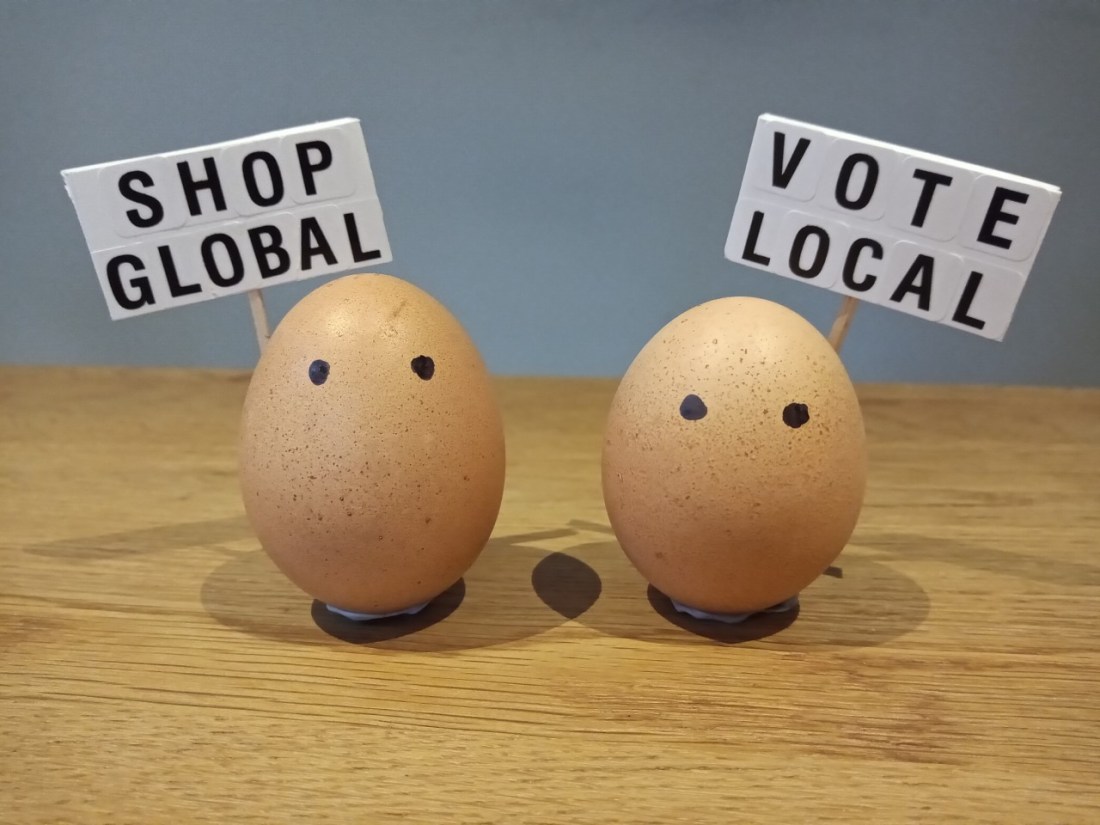
Shop global, vote local

The demand for cheap goods and strong government might be too much

One of the catch cries of the environmental movement urges us to “think global, act local”. This slogan points to how our actions in our community can have an impact on a bigger scale. Paraphrasing this in the title of the blog refers to how the economic and political actions of some can work in opposite directions. When out shopping, we often get lured in by cheaper goods on offer thanks to globalization, while many are voting in opposition to the global economy that keeps prices down. With people being tugged in both directions, there might not be a way out.

From the consumer’s point of view, globalization has resulted in a bonanza in terms of a growing selection of goods at low prices. Everything from clothing to computers has benefited from production being coordinated on a global scale. Globalization can achieve more for less because it increases the size of the market for many businesses. In general, a larger number of goods being produced at one place will typically have lower costs. So it would be cheaper in most cases if goods can be produced in large quantities and then shipped around the world (especially if transport costs are low). This approach also means that production can be situated where it is most efficient rather than close to where the goods will be consumed.

The lower price tags for global goods means that we can buy more, but also that production for international markets is also likely to shrink. The reason being that higher levels of output acts as a spur for automation which involves more machinery and fewer workers relative to the output. Offshoring of manufacturing jobs and basic service-sector work has added to this trend within industrialized countries where the wages are higher than elsewhere. The result is that most people are global consumers to a certain extent, while fewer and fewer people provide goods for the global market.

On top of this, global jobs have increasingly become concentrated mainly in the cities, stripping many other places of high-paying work. The more the pay packets of the locals in such communities take a battering, the greater the attraction of the cheap products that globalization is good at offering up. Even though neighbourhood businesses are likely to suffer due to this, the government has little power to mitigate the impact especially as social solidarity is on the wane. It is not surprising then that many people left behind in the wake of these changes end up feeling powerless and abandoned. Not only have jobs disappeared but individuals have been left with few meaningful ways of contributing to the economy so as to earn a wage.

With the negative effects of globalization being concentrated in specific places, location has become a more important issue in politics. Many people see their own prosperity as closely tied to the economic wellbeing of their own neighbourhood. When this manifests itself in political terms, the nation state thus becomes the obvious flagpole to rally around for those on the economic backfoot. But this resurgence in patriotic sentiment has come with its own problems, and rather than providing solutions, has split society into rival camps that do little but bicker.

An obvious solution would be to get more people to “shop local” as promoted in many corners of the world. Although buying things from stores in your neighbourhood does help a bit, it matters more where the goods are produced (although lots of services are produced locally). The trend to buy locally source agricultural produce (particularly common among people in city who would tend to “vote global”) is a step up but unlikely to be substantial enough relative to the size of global economic flows.

If those who “vote local” can only afford to “shop global”, the situation seems more likely to get worse especially since the political system seems to offer little scope for improvement. Democracy would normally find a way to mediate between competing claims but the traditional split between left and right is not set up to cope with these issues. Instead, it is our politics that is also being cheapened by the division that globalization has wrought. And it is something for which we might have to pay a lot more for as the situation is only likely to deteriorate.

Paleopolitics

Without a shared way of looking at the world, the changing economy has split us into warring tribes

Diets tend to be faddish but even the Free Range Economist got caught up in the notion of the paleo diet. The idea behind it is that our stomachs evolved over thousands of years to the foods (such as vegetables, nuts, and fish) that we would eat back when we were hunters and gatherers. The same concept can be applied to how are minds developed to operate within small tribes so as to ensure that the group (and hence the individuals within it) would survive. The means by which we have been able to move towards interacting with more and more people has been eroded away as economic changes impact on how people understand the world around them.

Humans, like all other creatures, have adapted over time to better fit in with their environment. Our bodies developed to survive feast and famine and we still store up any extra calories, but rather than being helpful in the modern world, this now causes problems such as obesity. Our minds also are fine-tuned to operate in relatively small groups of a hundred or so people based around the larger family unit. While the world around us has changed, our tribal brain can also play havoc with how we cope with life in a global world.

Previously, the key for survival would be a strong group identity so that everyone would put in their all to guarantee the survival of the whole even if it were to mean sacrifices for the individuals. One way of doing this was to create clear boundaries between those within the group and outsiders who were often viewed with distrust. But the growth of larger and larger social groups shows our ability to go beyond these basic building blocks for society and work together with people from different backgrounds.

The key to managing bigger masses of people outside of our kinship grouping is shared narratives that bind everyone together. These narratives develop over time so that society can expand in size and get individuals working together for the good of the whole. In this way, society became more inclusive despite its past of excluding people from outside a narrow group. Religion and nationalism were two such grand narratives that help large numbers of people work together toward common goals while also accepting new recruits that shared their beliefs.

In more recent times, economic progress has become the rallying cry for society. We rely on the economy for lots of our wants and needs and toil away to do our bit. It is understood that economic activity might result in job losses or businesses going bust, but the economy had also provided people with a way to get back on their feet. The economy does not instill devotion or passion in the same way as religious or patriotic beliefs, but steady improvements in our daily lives meant that most people were happy to do their bit.

Things seemed be going so well with solid growth in the few decades up to the 1970s that people rallied together to form a generous welfare state for the less fortunate. However, these years of plenty slowly melted away with the rise of globalization along with automation and computers that have eroded away economic gains for many. The effects of these trends have not been even but have instead resulted in a large portion of the population seeing their livelihood stagnate while others continued to prosper.

While religion or past national glories might provide some consolation for those who have fallen on hard times, economics provides little comfort. There is the expectation that those without jobs or those not earning high enough wages should move elsewhere or take up new skills to find better work. After all, it is expected that each of us will do our share and thus earn a wage. Yet, what the economy provides, the economy can also take away, and as such, many previously prosperous areas in industrialized countries have suffered from seemingly terminal decline. Flight was the preferred option for many but those who stayed to fight have struggled as economic activity has drained away.

As well as suffering through a lack of job opportunities, those left behind have had to go without a helping hand from their own countrymen and women. On top of this, the story that economics would tell suggests that it is all their own fault and that they have no one to blame but themselves. With this tale not looking likely to have a happy ending, it is little wonder that many have turned to conspiracy theories so as to understand why previously industrious folk have ended up falling on hard times. The situation is further compounded by minorities on issues such as race, gender, and sexuality seeming to be getting a lot more sympathy from some.

For their part, those still happy with how the economy operates see those without work or decent jobs as not playing by the rules. Those who have prospered hold themselves as examples that anyone should be able to succeed. And we rely more on those who thrive to spur on the economy so we tend to have little compassion for those who struggle (which is one of the reasons why tax rates have been falling). Instead, the left behinds are often looked down upon for not being able to keep up with progress or being fooled into supporting populist politicians.

Despite the obvious analogies, this is more than an us-versus-them story but one in which many people have lost faith in their economic future. While immigrants have taken some of the blame, tribalism looks set to become particularly fierce among people that look alike but who have differing economic fortunes. Our past tribal selves might have treated outsiders with disdain, but the worst treatment was dished out to those within the group who did not look after their own. Without a shared story to believe in anymore, our disagreements could swell over so as to push back against further economic progress.

To transcend the tribalism within each different countries, the narrative of economic progress needs to be rebuilt so that it rings true again for the majority of the population. The assumption being that issues of culture and identity could potentially ease if more people had control of their economic destinies. Otherwise, the increasing rancor will continue to mount and only make the issues worse. Tribes are not so good at working together but are instead much better suited to warring with one another. But conflict will not help us progress and is instead more likely to drive us all nutty (and not in the good paleo diet way).